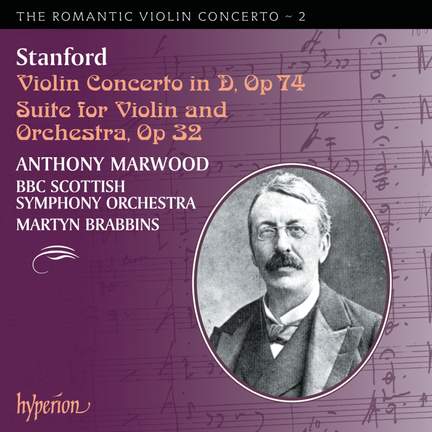
The Romantic Violin Concerto 2 - Stanford
Anthony Marwood (violin)
BBC Scottish Symphony Orchestra, Martyn Brabbins
Awards:
-
Gramophone Magazine, February 2001, Disc of the Month

This is a discovery of major importance. Hubert Parry (no mean critic) regarded Stanford's Violin Concerto as one of his finest works, yet it has been played rarely, if at all, since his death...
The Romantic Violin Concerto 2 - Stanford
Anthony Marwood (violin)
BBC Scottish Symphony Orchestra, Martyn Brabbins
Purchase product

Awards:
-
Gramophone Magazine, February 2001, Disc of the Month
This is a discovery of major importance. Hubert Parry (no mean critic) regarded Stanford's Violin Concerto as one of his finest works, yet it has been played rarely, if at all, since his death...
About
Stanford was a more-than-proficient violinist during his youth and performed numerous violin concertos as an experienced conductor. From his early years in Dublin, Stanford came to know Joachim and as Stanford grew older and his prodigious ability became more apparent, Joachim began to take a serious interest in his future. Later, while Stanford was at Cambridge, their strong artistic and personal relationship cemented. The Suite for Violin and Orchestra was written as a homage to Joachim which would stand both as a tribute to his friend's brilliance as a great virtuoso and musician and as a portrait of his musical enthusiasms for Bach, Beethoven, Mendelssohn, Spohr and Brahms. The work was premiered by Joachim in Berlin in 1889 and was a great success. The violin concerto was composed in 1899 and first performed in 1901 with very little critical notice. This changed, however, when it was played by Fritz Kreisler. Although viewed by those such as Parry as one of his finest works, it did not establish itself in the canon of popular concertos. The work has remained virtually unknown, its passion and soul locked away in the pages of Breitkopf und Hartel's unpublished full score and parts recently discovered in the library of the RCM.
Contents and tracklist
Awards and reviews
-
Gramophone MagazineFebruary 2001Disc of the Month
 2010
2010
This is a discovery of major importance. Hubert Parry (no mean critic) regarded Stanford's Violin Concerto as one of his finest works, yet it has been played rarely, if at all, since his death in 1924. One preliminary word of warning though: despite Stanford's reputation as a disciple of Brahms, don't listen to this concerto expecting it to sound Brahmsian. Often enough it does, but when it doesn't it isn't because Stanford has failed to match the quality of his 'model'; far more often it's because he's going his own way, speaking with his own and not a derivative voice.
The very opening of the concerto is a case in point: the soloist's melody is accompanied by a beautifully delicate texture of plucked strings and rippling woodwind. There's nothing quite like it in Brahms; nor is Brahms always so generous with his thematic material as Stanford is in this movement. After that 'first subject' and an extensive and varied 'second subject group', a big and dramatic orchestral tutti leads not to the expected development but to a new and quite splendid theme. There's plenty of room for virtuosity, but very often the display is modified by a pensive quality, a reticence, that's seemingly Stanford's own, and most attractive.
The slow movement is also notable for its individual scoring (very spare at the outset; a magical return of the melancholy opening melody at the end over murmuring tremolando strings) and for its melodic distinction. The sadness of the first theme is again reticent, adding greatly to the eloquence of the heartfelt tutti that leads to the finest theme in the entire work, upon which Stanford lavishes rhapsodic figuration of great beauty.
There's not a player better suited to bringing this concerto back to life than Anthony Marwood.
He easily surmounts its technical demands, but his distinction as a chamber musician enables him to seek out all its quieter subtleties and pensive asides. The Suite is a lesser but still highly entertaining work, an exercise in neo-Baroque designed as a warmly affectionate tribute to Joseph Joachim. Its sheer ingenuity (the first movement, for example, is a combination of sonata form and two sets of interlocked variations) saves it from being a mere exercise, and its melodic freshness from being a mere makeweight to the masterly concerto. First-class orchestral playing, sympathetically conducted, and a recording that's both clean and spacious.