

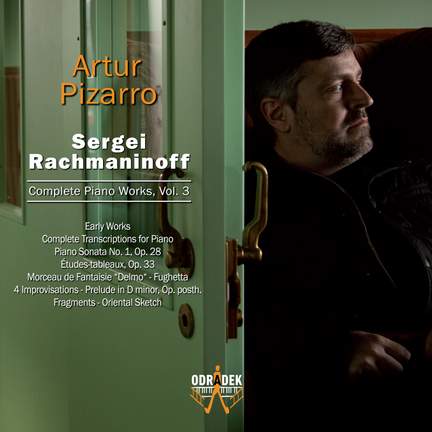
Sergei Rachmaninoff: Complete Piano Works Vol. 3
Artur Pizarro (piano)
Pizarro is at his most expansive in the Sonata, delivering many passages of wonderfully reflecctive playing, especially in the central slow movement…[he] conjures up some marvellously rich sonorities…[and]...
Sergei Rachmaninoff: Complete Piano Works Vol. 3
Artur Pizarro (piano)
Purchase product

Pizarro is at his most expansive in the Sonata, delivering many passages of wonderfully reflecctive playing, especially in the central slow movement…[he] conjures up some marvellously rich sonorities…[and]...
About
Distinguished Portuguese pianist Artur Pizarro concludes his landmark recording of the ‘Complete Piano Works’ of Sergei Rachmaninoff for Odradek Records with its third volume.
Among the compositions on this 3-CD set are the early Suite in D minor, only recently re-discovered and given its premiere (it is thought) in 2007, the Piano Sonata No. 1, the Etudes-tableaux, op 33, Rachmaninoff’s transcriptions of other composers - from Mendelssohn and Bizet to Rimsky-Korsakov’s ‘The Flight of the Bumble Bee’ - and a host of miniature pieces.
Artur Pizarro is renowned for his performances of Rachmaninoff. A former winner of the Leeds Piano Competition (he played the Third Concerto when he won the competition in 1990), Pizarro offers his listeners a lifetime of love for, and experience with, this music which speaks, as he says, “of the endless variety of the human condition”.
A 7-CD set comprising all three volumes of Pizarro’s Rachmaninoff solo piano recordings will be released in early 2016. Another new Pizarro album is Rachmaninoff’s Piano Trio No. 2 in D minor ‘Trio élégiaque’ with violinist Christian Tetzlaff and cellist Tanja Tetzlaff for the Avi Music label (AVI8553335). In 2014, Artur Pizarro and the Italian pianist Rinaldo Zhok formed a duo for both the piano duet and two piano repertoire. Their debut disc together - of music by Antonin Dvorak - will also be released by Odradek.
Contents and tracklist
Awards and reviews
 November 2016
Pizarro is at his most expansive in the Sonata, delivering many passages of wonderfully reflecctive playing, especially in the central slow movement…[he] conjures up some marvellously rich sonorities…[and] is particularly persuasive in the precocious epigrammatic pieces Rachmaninov composed as a teenager
