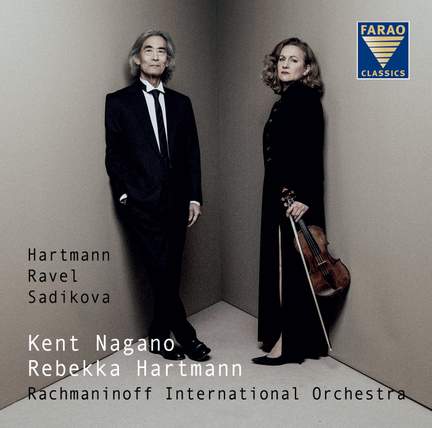
Hartmann | Ravel | Sadikova
Rebekka Hartmann (violin), Rachmaninoff International Orchestra, Kent Nagano
there's no doubting the commitment of the playing, and the tightly controlled orchestral contribution throughout.
Hartmann | Ravel | Sadikova
Rebekka Hartmann (violin), Rachmaninoff International Orchestra, Kent Nagano
Purchase product

there's no doubting the commitment of the playing, and the tightly controlled orchestral contribution throughout.
About
Crises, divisions, nationalism the beautiful utopia that is the potential of a united Europe is being thrown into disarray. This special recording by the Rachmaninoff International Orchestra under Kent Nagano, together with violinist Rebekka Hartmann, reveals the strength of the connection between different European cultures. The musicians have recorded three works from the twentieth and twenty-first centuries: three works that bear witness to Europe's culture and its strength, from a perspective that transcends national borders. Karl Amadeus Hartmann's Concerto funebre from 1939 dates back to the continents darkest period. Hartmann does not employ a simple or brilliant language for those dark times under the Nazi terror in Germany, but interprets his time in a complex and multilayered way. But he still builds a bridge with his music, quotes a Russian revolutionary funeral march, and looks beyond his own cultural sphere.
The violin concerto Stradivari by Uzbek composer Aziza Sadikova from 2020 points in the other direc-tion. Inspired by a Soviet television film from the 1980s, her music journeys from the Italian Baroque to the present. It draws on Europe's rich cultural heritage and does not raise up any borders, disco-vering in the process a beautiful present and future. Maurice Ravel had a similarly open and benevolent view of his home continents cultural heritage a hundred years earlier. His Tzigane is inspired by the music of the Roma. But even today, in Ravel's piece we hear less the appropriation of such music into a Western European soundscape than the fascination of a Western European for this specific kind of musical expression. Joy, affection, and the openness to a foreign culture are what characterize this piece.
Contents and tracklist
Awards and reviews
 October 2025
there's no doubting the commitment of the playing, and the tightly controlled orchestral contribution throughout.