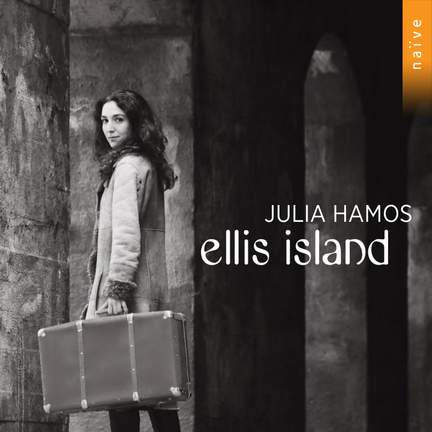
Ellis Island
Julia Hamos (piano)
Awards:
-
Gramophone Magazine, July 2025, Editor's Choice

The shifts from unsettling ellis island Kurtág to the comforting, tonal minimalism of Monk and Mingus effectively illustrate a profound journey but it's in the Bartók that Hamos really flies,...
Ellis Island
Julia Hamos (piano)
Purchase product

Awards:
-
Gramophone Magazine, July 2025, Editor's Choice
The shifts from unsettling ellis island Kurtág to the comforting, tonal minimalism of Monk and Mingus effectively illustrate a profound journey but it's in the Bartók that Hamos really flies,...
About
"Ellis Island" is an odyssey in sound, the story of a pianist with dual origins, Julia Hamos, who, in this very first album, looks at her family roots, American and Hungarian, and displays a longing for adventure. She looks towards the Hungary of Bartok and Kurtag, engaging in a dialogue with the memory of her ancestors from Transylvania. Originally from the same region as Kurtag, her maternal grandfather knew Ligeti as a child.
This journey with it's haunting poetry will lead us also to New York, the pianist's first home, a place of hope and inspiration, which always feeds her creativity. Myself When I Am Real by Charles Mingus bursts forth, a fabulous moment, both poetic and pianistic, the zenith of this unusual and personal journey where the pianist, with a mellow yet clear sound palette, will have brought together in a fluid gesture the waking dreams of Schubert (Ungarische melodie, 1824), the very earthy and despair-tinged folklore of Bartok (Fifteen Hungarian Peasant Songs) and the torrential and enigmatic explosions of early Kurtag (8 Pieces Op. 3).
In this eminently personal journey, however, there is no narcissistic temptation. Because if the young musician plays, she above all wants to speak to us, with modesty, but not without determination. Her piano assembles words, choreographs rhythms, and also deploy it's range of pastels colours. This is demonstrated by the subtle selection of Jatekok, where the piano will embody a thousand faces, in turn itself (Capriccioso), percussion (Play with Overtones), harp (Perpetuum mobile) or violin duet with viola (Tears).
The two cycles of Bartok, with their characters so ironically sketched (Fifteen Hungarian Peasant Songs) and their sparkling rhythms (6 Dances in Bulgarian Rhythm), are no less alive. From the pianist's supple playing, from her silky legato, final streaks of melancholy will often escape.In all respects, "Ellis Island" is a fascinating experience - that of an artist who has found her voice.
Contents and tracklist
Awards and reviews
-
Gramophone MagazineJuly 2025Editor's Choice
 December 2025
The shifts from unsettling ellis island Kurtág to the comforting, tonal minimalism of Monk and Mingus effectively illustrate a profound journey but it's in the Bartók that Hamos really flies, her securely cushioned technique couching their springy, jagged rhythms with ease.
 July 2025
She provides her own extensive and thoughtful annotations, discussing what characterises the selections and why the music is important to her. More important to us, however, are the sheer finesse, innate musicality and total commitment informing every note she plays, not to mention the gorgeous recorded sound.