Konzert Im Bachhaus Eisenach
David Shemer (historical keyboard instruments), Walter Reiter (baroque violin)
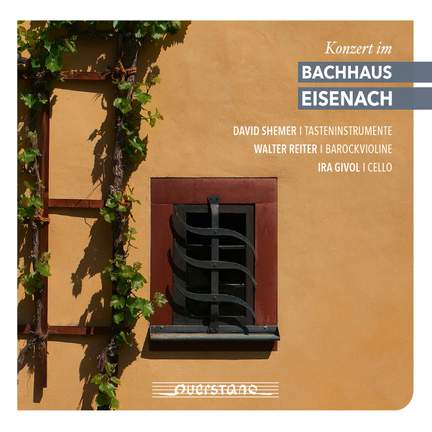
Konzert Im Bachhaus Eisenach
David Shemer (historical keyboard instruments), Walter Reiter (baroque violin)
Purchase product
About
The idea for this CD came about on the occasion of concerts on October 28 and 31, 2021, in which Bach works for violin and keyboard instrument were performed in front of enthusiastic audiences in the Bach House as part of the annual Eisenach Bach Festival.
The recordings were made in 2022 in the museum's instrument hall. The order on the double CD follows the original live program. David Shemer plays fve historical keyboard instruments from the collection of the Bach House Eisenach, Walter Reiter a baroque violin by Matthias Klotz from 1727.
The Six Sonatas for Violin and Harpsichord (BWV 1014-1019), which form the core of the program, date from Bach's Kothen period and are considered to be the forerunners of the classical sonatas for violin and piano by Mozart or Beethoven, for example. The frst fve of these sonatas are in the traditional form of the church sonata with the movement pattern slow - fast - slow - fast. The sixth sonata in G major, which has fve to six movements depending on the version, is out of the series. Bach revised it several times, and in the second version (BWV 1019.2) he added a new "Cantabile" based on the aria "Heil und Segen" from the cantata "Gott, man lobet dich in der Stille" (BWV 120) which is also played in the program.
The Sonata in G major (BWV 1021) for violin and basso continuo was only discovered in 1928. It is preserved in a manuscript made partly by Bach and partly by his second wife Anna Magdalena. Here Ira Givol also plays on a baroque cello by Pieter Rombouts from 1720. The Sonata in E minor (BWV 1023) could have been written during Bach's Weimar period. Its only copy preserved in Dresden probably comes from the estate of the violin virtuoso Johann Georg Pisendel.
In 1739, on the 200th anniversary of the Reformation in Leipzig, Bach had the third part of his "Clavierubung" printed, the so- called Organ Mass, by his own publishing house. At the end of the mass he composed four duets that can be played on the harpsichord or organ. These works round off the concert and thus also the CD program.
Contents and tracklist
- David Shemer (soloist), Walter S. Reiter (soloist), Ira Givol (soloist)
- David Shemer (soloist)
- David Shemer (soloist), Walter S. Reiter (soloist)
- David Shemer (soloist), Walter S. Reiter (soloist)
- David Shemer (soloist)
- David Shemer (soloist), Walter S. Reiter (soloist)
- David Shemer (soloist), Walter S. Reiter (soloist), Ira Givol (soloist)
- David Shemer (soloist), Walter S. Reiter (soloist)
- David Shemer (soloist)
- David Shemer (soloist), Walter S. Reiter (soloist)
- David Shemer (soloist), Walter S. Reiter (soloist)
- David Shemer (soloist), Walter S. Reiter (soloist)
- David Shemer (soloist)
- David Shemer (soloist), Walter S. Reiter (soloist)