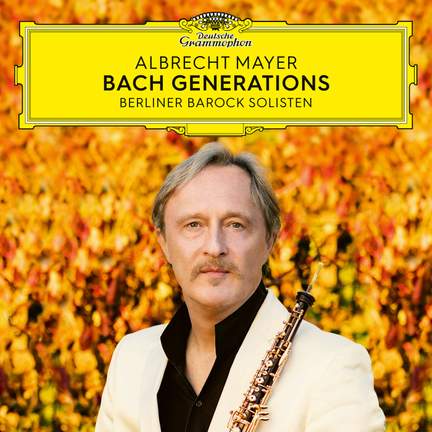
Bach Generations
Albrecht Mayer (oboe), Berliner Barock Solisten
Awards:
-
Presto Editor's Choice, August 2023

Mayer switches between oboe, oboe d'amore and cor anglais for this portrait of four members of the Bach dynasty, and his virtuosity on all three is breathtaking: the finale of JS's Keyboard...
Bach Generations
Albrecht Mayer (oboe), Berliner Barock Solisten
Purchase product

Awards:
-
Presto Editor's Choice, August 2023
Mayer switches between oboe, oboe d'amore and cor anglais for this portrait of four members of the Bach dynasty, and his virtuosity on all three is breathtaking: the finale of JS's Keyboard...
About
After the huge success of his previous Deutsche Grammophon album, devoted to works by Mozart, oboist Albrecht Mayer turns his attention to the uniquely talented Bach family. For Bach Generations, he has chosen a selection of music by four members of the family: Johann Sebastian himself (1685-1750), Johann Christoph (1642-1703), Carl Philipp Emanuel (1714-1788) and Johann Christoph Friedrich (1732-1795). There is also a transcription of a work by Gottfried Heinrich Stölzel, previously attributed to J.S. Bach. Bach Generations is recorded with the Berliner Barock Solisten and Gottfried von der Goltz (solo violin/concertmaster).
Albrecht Mayer discovered the music of J.S. Bach at the age of 8, as a choirboy at Bamberg Cathedral. Within a couple of years he was able to play some of the composer’s simpler keyboard pieces on the piano. “Even then,” he recalls, “I could feel this transcendent image of his music going through my veins.” The more he studied Bach the more he loved his writing. As he notes, however, its power does not require specialist knowledge. “You can dive very deep into his music, but even when you have no idea about it, it still speaks to your heart.” In recent years, Mayer’s research has focused on the wider Bach family – this album is based on the thread of genius that runs through the different generations to produce works that embrace the styles of the late-Renaissance, Baroque and Classical eras.
That sense of stylistic progression is reflected in the concertos by Johann Sebastian and two of his sons that lie at the heart of Bach Generations. J.S. Bach’s Concerto for Oboe d’amore in A major only survives in a version for keyboard (BWV 1055), but there are strong indications that it was originally for oboe, an instrument for which the composer wrote prominent parts in many of his cantatas. In this work we hear the strict Baroque separation between the solo instrument and the orchestra, which plays an accompanimental role.
While there are virtuoso solo moments in C.P.E. Bach’s Oboe Concerto in G major, arranged by Matthias Spindler and Albrecht Mayer from a keyboard concerto (H412/Wq 9), the orchestra is beginning to take on more prominence. The work’s turbulent outer movements and empfindsam central Adagio make it a typical mid-18th-century composition.
By contrast, in J.C.F. Bach’s Concerto for Oboe in B flat major (arranged by Spindler and Mayer from a keyboard concerto composed in the 1770s), much of the interest lies in the orchestral writing, and the work as a whole assimilates elements of the Classicism of Haydn or Mozart. The originality of this and the C.P.E. Bach concerto reveals much about Johann Sebastian’s teaching abilities. While he passed on his craft to his sons, he did not create composers in his own image, but enabled them to develop their own personal idioms.
Three shorter works by Bach the teacher are included here too. Alongside an cor anglais transcription of the well-known Air (“on a G string”) from Orchestral Suite no.3, we hear Spindler’s oboe arrangement of the Badinerie from Orchestral Suite no.2 and an oboe d’amore adaptation of the tenor aria “Sanfte soll mein Todeskummer” from the Easter Oratorio. Mayer also performs a transcription for oboe of “Bist du bei mir”, a song by Gottfried Heinrich Stölzel that was a favourite in the Bach household.
The album ends with the earliest work of the selection. With its roots in the late Renaissance period, Ach, dass ich Wassers g’nug hätte is a sacred vocal work by Johann Christoph Bach, a cousin of J.S. Bach’s father, and has been adapted for cor anglais by Matthias Spindler. “We’re trying to imitate a singer as much as we can,” says Mayer about the challenge involved in such a transformation. “Just because you skip the text, the music is no less sacred, no less good.”
Contents and tracklist
- Adapted for Oboe d'amore, Strings and Basso continuo
- Albrecht Mayer (oboe d amore), Berlin Barock Solisten (chamber ensemble), Albrecht Mayer (oboe)
- Recorded: 2023-02-01
- Recording Venue: Siemens-Villa, Berlin
- Transcr. for Corno inglese, Strings and Basso continuo
- Albrecht Mayer (cor anglais), Berlin Barock Solisten (chamber ensemble)
- Recorded: 2023-02-01
- Recording Venue: Siemens-Villa, Berlin
- Arr. Spindler for Oboe, Strings and Basso continuo
- Albrecht Mayer (oboe), Berlin Barock Solisten (chamber ensemble)
- Recorded: 2023-02-01
- Recording Venue: Siemens-Villa, Berlin
- Arr. Mayer & Spindler for Oboe, Strings and Basso continuo
- Albrecht Mayer (oboe), Berlin Barock Solisten (chamber ensemble), Albrecht Mayer (cadenzor)
- Recorded: 2023-02-01
- Recording Venue: Siemens-Villa, Berlin
- Formerly Attrib. J.S. Bach as BWV 508, Transcr. for Oboe, Solo Violin, Strings and Basso continuo
- Albrecht Mayer (oboe), Gottfried von der Goltz (violin), Berlin Barock Solisten (chamber ensemble)
- Recorded: 2023-02-01
- Recording Venue: Siemens-Villa, Berlin
- Adapted for Oboe d'amore, 2 Recorders, Strings and Basso continuo
- Albrecht Mayer (oboe d amore), Berlin Barock Solisten (chamber ensemble)
- Recorded: 2023-02-01
- Recording Venue: Siemens-Villa, Berlin
- Arr. Mayer & Spindler for Oboe, Strings and Basso continuo
- Albrecht Mayer (oboe), Berlin Barock Solisten (chamber ensemble), Albrecht Mayer (cadenzor)
- Recorded: 2023-02-01
- Recording Venue: Siemens-Villa, Berlin
- Arr. Spindler for Corno inglese, Solo Violin, Strings and Basso continuo
- Albrecht Mayer (cor anglais), Gottfried von der Goltz (violin), Berlin Barock Solisten (chamber ensemble)
- Recorded: 2023-02-01
- Recording Venue: Siemens-Villa, Berlin
Spotlight on this release
-
An error occurred.
Try watching this video on www.youtube.com, or enable JavaScript if it is disabled in your browser.
-
An error occurred.
Try watching this video on www.youtube.com, or enable JavaScript if it is disabled in your browser.
-
An error occurred.
Try watching this video on www.youtube.com, or enable JavaScript if it is disabled in your browser.
-
An error occurred.
Try watching this video on www.youtube.com, or enable JavaScript if it is disabled in your browser.
-
An error occurred.
Try watching this video on www.youtube.com, or enable JavaScript if it is disabled in your browser.
Awards and reviews
-
Presto Editor's ChoiceAugust 2023
 August 2023
Mayer switches between oboe, oboe d'amore and cor anglais for this portrait of four members of the Bach dynasty, and his virtuosity on all three is breathtaking: the finale of JS's Keyboard Concerto No. 4 positively bubbles with energy and Mayer's own cadenzas (complete with a few little intertextual references) often seem to defy gravity.