Special offer. Hungarian Songs: Bartok, Kodaly & Ligeti
Katalin Károlyi (mezzo-soprano), Klára Würtz (piano)
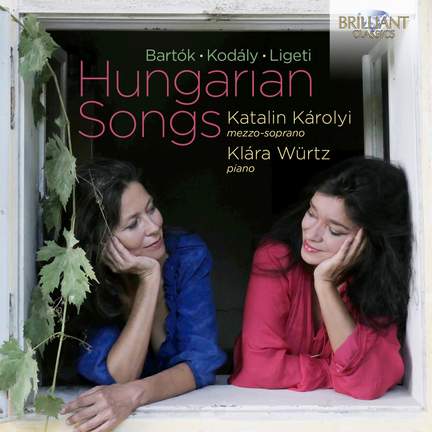
Katalin Károlyi sings with ravishing tones, her bright mezzo often asked to navigate the soprano range. Her pitch is generally right on, so when a few surprise “off-color” notes do occur in...
Special offer. Hungarian Songs: Bartok, Kodaly & Ligeti
Katalin Károlyi (mezzo-soprano), Klára Würtz (piano)
Purchase product

Katalin Károlyi sings with ravishing tones, her bright mezzo often asked to navigate the soprano range. Her pitch is generally right on, so when a few surprise “off-color” notes do occur in...
About
Only one year and a half after their first meeting in Budapest in early 1905, Bartók and Kodály were eager to jointly publish their first settings of Hungarian folk songs. In their foreword to the volume Magyar népdalok (Hungarian Folk Songs), they declare their goal thus: “…to get the general public to know and appreciate folk songs.”
The Ten Hungarian Folk Songs from 1906 (BB 43), Bartók’s earliest and still quite rudimentary but imaginative and very sensitive folk-song arrangements, were collected by the 25-year-old himself mostly in three regions of the Hungarian countryside: near Budapest, Békéscsaba, and the lake Balaton. This set, from which we can listen to four arrangements on this cd, has never been offered by Bartók to be published. Having collected peasant music from regions of the Hungarian Kingdom where significant Romanian and Slovak minorities lived, Bartók immediately became intrigued by the peculiarities – and from his point of view, musical freshness – of both nations’ songs and instrumental dances. His reverence for the folklore of the Slovaks can be felt in the five arrangements of the Falún (Village Scenes) series (BB 87a), composed in 1924 and based on folk songs from the Zólyom (in Slovakian: Zvolenská) region of what was then Upper Hungary (now Slovakia) he collected in 1917 from village women. These arrangements of bursting energy, enchantingly deep emotionality and transcendence also bear testimony to Bartók’s discovery of Stravinsky’s music which he was galvanised by in the early 1920s. The texts are sung by Katalin Károlyi in Hungarian here, not in their original Slovak-language version.
Before leaving Hungary for Austria and West Germany after the fall of the 1956 revolution, György Ligeti (1923–2006) not only collected folk music in his native Transylvania but also worked for the Institute for Folklore in Bucharest and Kolozsvár in the late 1940s. Thus, in his twenties and thirties, he followed the footsteps of his idols, Bartók and Kodály. In the last months of 1952, Ligeti set to music five poems by János Arany, a leading figure of 19th-century Hungarian poetry. Both text and music are deeply rooted in Hungarian folk songs; indeed, most of Ligeti’s melodies, or parts thereof, could be actual folk songs, just like Arany’s texts from almost a century earlier could be folk-song texts. The last piece is an exception, being a daring musical setting of Arany’s 1868 Hungarian translation of Robert Burns’ humorous song The Deil’s Awa Wi’ Th’ Exciseman (1792).
Other information:
- Recorded at the Westvest Kerk, Schiedam, The Netherlands
- Booklet in English contains liner notes by László Stachó, and profiles of the artists
- This attractive song program brings together three composers who share a common language, as well as their search for the inclusion of folkloristic elements in their own, unmistakably personal style.
- The Hungarian language, with its unique rhythm and emphasis, has strongly stamped the country’s folk music, and the music of Bartók, Kodály and Ligeti is inseparable from its roots and inspiration. Béla Bartók and Zoltán Kodály both roamed the Hungarian and Rumanian countryside in search of near-lost songs and vocal traditions, notating and recording a wealth of folk music thus saved for posterity.
- This program presents songs in Hungarian, capturing the spirit of the Hungarian soul: playful, passionate, melancholy and joyful.
- Sung by Katalin Károlyi, one of Hungary’s foremost mezzo-sopranos, whose repertoire stretches from Renaissance to contemporary music. She sang and recorded with William Christie, and György Ligeti wrote for her his important work for voice and ensemble “Sippal, Dobbal..”. Klára Würtz’ extensive discography for Brilliant Classics and Piano Classics brought her many prizes and top reviews, among which a Gramophone Editor’s Choice and a 10/10 on Classicstoday.com.
Contents and tracklist
- Katalin Károlyi, Klára Würtz
- Katalin Károlyi, Klára Würtz
- Katalin Károlyi, Klára Würtz
- Katalin Károlyi, Klára Würtz
- Katalin Károlyi, Klára Würtz
- Katalin Károlyi, Klára Würtz
- Katalin Károlyi, Klára Würtz
- Katalin Károlyi, Klára Würtz
Awards and reviews
 Jan/Feb 2024
Katalin Károlyi sings with ravishing tones, her bright mezzo often asked to navigate the soprano range. Her pitch is generally right on, so when a few surprise “off-color” notes do occur in two songs, one assumes they were written in semitones. Klára Würtz is always right with her and excels in Bartók’s excursions into virtuosity.