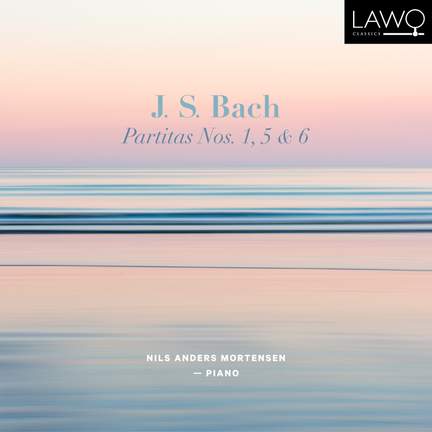
J.s. Bach: Partitas Nos. 1, 5 & 6
Nils Anders Mortensen (piano)
These well-recorded performances are never less than impressive technically, but of ten they just fail to deliver the complete picture.
J.s. Bach: Partitas Nos. 1, 5 & 6
Nils Anders Mortensen (piano)
Purchase product

These well-recorded performances are never less than impressive technically, but of ten they just fail to deliver the complete picture.
About
On this recording, Norwegian pianist Nils Anders Mortensen presents three of the six partitas for keyboard (nos. 1, 5 and 6). There will be a second CD with the three remaining partitas (nos. 2, 3 and 4). Bach composed ten partitas - three for solo violin, one for solo flute and six for keyboard. As the term partita may mean, to quote from the Oxford Composer Companion to Bach, "a suite of dances or a set of variations" - it is no more precise than many other musical terms. If there is no obvious difference between the partita and the suite, there seems to be no justification for two separate terms. In the sixteenth century partita indicated one of a sequence of variations, but this meaning evolved, coming to signify a collection of movements and later - by the time of Bach's keyboard partitas - a suite of dances. Bach's six partitas for keyboard, BWV 825-830, were published individually beginning in 1726, then, in 1731, as a group entitled Clavier-?bung 1 (?bung may be translated as practice or exercise). Among what may be described as Bach's various sets of dance-suites - also including the English Suites and the French Suites - the partitas are the most technically demanding. Johann Kuhnau, Bach's predecessor as cantor of St. Thomas's Church in Leipzig, had published a collection of partitas under the title Clavier-?bung - two volumes (1689 and 1692), each containing seven works. These two collections by Kuhnau, together with two other volumes which he published during his time at Leipzig, proved to be an important influence on German keyboard music. Bach's keyboard partitas in general mark a further advance on his French Suites - even more adventurous in terms of new handling of the dance-forms, more favouring of galant melody-with-harmony rather than imitative counterpoint, and new types of texture. With regard to the dance-movements in particular, Bach shows remarkable creative freedom and diversity while departing from the traditional models.
Contents and tracklist
- Nils Anders Mortensen (piano)
- Nils Anders Mortensen (piano)
- Nils Anders Mortensen (piano)
Awards and reviews
 July 2023
These well-recorded performances are never less than impressive technically, but of ten they just fail to deliver the complete picture.
 July 2023
At its best, this is elegant playing, without eccentricity or ostentation.