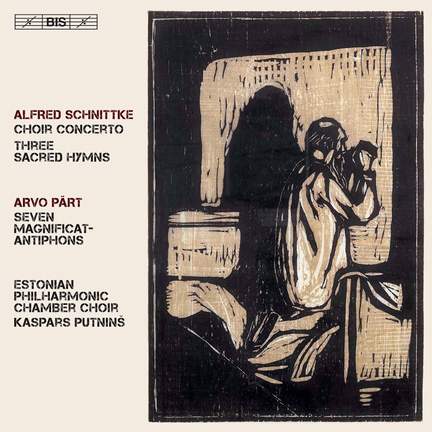
Schnittke: Choir Concerto
Estonian Philharmonic Chamber Choir, Kaspars Putnins
Awards:
-
Gramophone Magazine, July 2026, Critics' Choice 2021

-
Diapason d’Or, October 2021, Nouveauté

-
Presto Recordings of the Year, Finalist 2021

-
International Classical Music Awards, 2022, Nominated - Choral

-
Grammy Awards, 64th Awards (2022), Nominee - Best Choral Performance

-
Diapason d’Or de l’Année, 2021, Musique chorale
-
BBC Music Magazine Awards, 2022, Shortlisted - Choral

Even by their standards, the choir are on blindingly good form in Schnittke’s monumental Choir Concerto.
Schnittke: Choir Concerto
Estonian Philharmonic Chamber Choir, Kaspars Putnins
Purchase product

Awards:
-
Gramophone Magazine, July 2026, Critics' Choice 2021
-
Diapason d’Or, October 2021, Nouveauté
-
Presto Recordings of the Year, Finalist 2021
-
International Classical Music Awards, 2022, Nominated - Choral
-
Grammy Awards, 64th Awards (2022), Nominee - Best Choral Performance
-
Diapason d’Or de l’Année, 2021, Musique chorale
-
BBC Music Magazine Awards, 2022, Shortlisted - Choral
Even by their standards, the choir are on blindingly good form in Schnittke’s monumental Choir Concerto.
About
As Alfred Schnittke and Arvo Pärt both adopted the Orthodox faith in the 1970s, Orthodox choral traditions became increasingly prominent in their work, but both composers also looked to the music of the Western church. Schnittke’s Three Sacred Hymns set three prayers, familiar in the West as Ave Maria, the Jesus Prayer and the Lord’s Prayer, and evoke Orthodox chant. His Choir Concerto, on the other hand, draws on Russian choral music of the 19th century and the tradition of large-scale concert works based on Orthodox choral music. The texts by the medieval Armenian poet Gregory of Narek are informed by a humanistic individualism, with the poet directly expressing his emotions and often writing in the first person. In the case of Pärt, his detailed study of Orthodox chant caused him to develop his so-called ‘tintinnabuli’ system of composition as an extension of the harmonic practices of Orthodox choral music. He wrote his Seven Magnificat-Antiphons in 1988, applying the tintinnabuli technique to texts from the Catholic liturgy in the German language – a striking East-West hybrid. The Estonian Philharmonic Chamber Choir and Kaspars Putniņš have combined sacred works by Schnittke and Pärt before, their previous release on BIS earning them a prestigious Gramophone Award in the Choral Music category.
Contents and tracklist
Awards and reviews
-
Gramophone MagazineJuly 2026Critics' Choice 2021
-
Diapason d’OrOctober 2021Nouveauté
-
Presto Recordings of the YearFinalist 2021
-
International Classical Music Awards2022Nominated - Choral
-
Diapason d’Or de l’Année2021Musique chorale
 December 2021
Even by their standards, the choir are on blindingly good form in Schnittke’s monumental Choir Concerto.