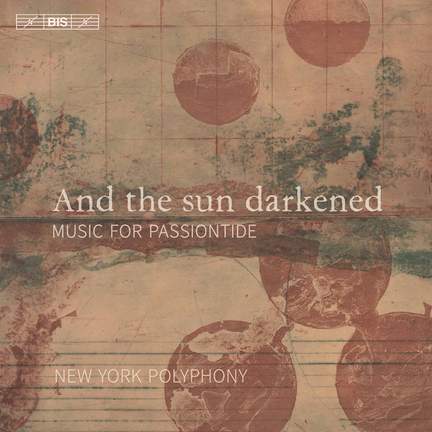
And the Sun Darkened
Music for Passiontide
New York Polyphony
Not surprisingly, this is unrelentingly austere stuff. If, however, choral gloom is your bag, it is also an imaginatively programmed recital, immaculately sung and recorded in superb sound.
And the Sun Darkened
Music for Passiontide
New York Polyphony
Purchase product

Not surprisingly, this is unrelentingly austere stuff. If, however, choral gloom is your bag, it is also an imaginatively programmed recital, immaculately sung and recorded in superb sound.
About
Resonating across more than five centuries, expressions of personal piety and prayer fill these works by a quartet of Franco-Flemish composers, all born in the 15th century, and their modern-day colleagues, Estonian Cyrillus Kreek (1889—1962) and British-Norwegian Andrew Smith (b. 1970). For those familiar with the vocal ensemble New York Polyphony and its previous, acclaimed releases on BIS, this exploration of the intersection of ancient and modern music is far from surprising: the group is known for its innovative programming. On And the sun darkened the four members follow Josquin's celebrated motet Tu pauperum refugium with Andrew Smith's setting of Psalm 55 – composed for NYP, it is a lament which nevertheless closes with an expression of confidence in God's justice. Sung in Estonian another biblical psalm is heard in Kreek's Taaveti laul 22 ('David's 22nd Song'), the text 'My God, why have you forsaken me' preparing the listener for the work that has given the disc its title. Officium de Cruce by Loyset Compère is a setting of a 14th-century hymn which follows the episodes of the Passion in a continuously flowing musical narrative: from the betrayal of Christ to his death – when the sun darkened – and entombment.
Contents and tracklist
Awards and reviews
 June 2021
Not surprisingly, this is unrelentingly austere stuff. If, however, choral gloom is your bag, it is also an imaginatively programmed recital, immaculately sung and recorded in superb sound.
 July 2021
There’s a deliberately unshowy quality to the Grammy-nominated quartet’s performances, which prioritise blend and pacing above obvious drama, that’s well suited to Compère’s contemplative Hours of the Cross.