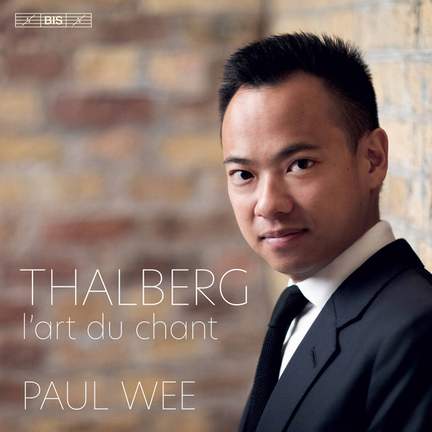
Thalberg: L’art du chant
Paul Wee (piano)
Awards:
-
BBC Music Magazine, January 2021, Instrumental Choice

Tone and touch are paramount, as Thalberg faithfully conveys the originals with an artistry far beyond that normally associated with transcription, managing to evoke a human voice accompanied...
Thalberg: L’art du chant
Paul Wee (piano)
Purchase product

Awards:
-
BBC Music Magazine, January 2021, Instrumental Choice
Tone and touch are paramount, as Thalberg faithfully conveys the originals with an artistry far beyond that normally associated with transcription, managing to evoke a human voice accompanied...
About
International lawyer by day and piano virtuoso by night, Paul Wee made his recording début in 2019 with some of the most technically demanding piano music there is: Alkan’s Symphony and Concerto for solo piano. He now returns with music which presents a different, but not lesser challenge: how make the keyboard sing. The piano is by nature a percussive instrument – the sound is created by little hammers falling on strings. To create a true legato – or the illusion of it – has been the aim of generations of pianists, but few have taken the matter as far as Sigismond Thalberg.
A giant in nineteenth-century pianism, Thalberg was born in 1812, the year after Franz Liszt, his greatest rival on the international concert circuit. In comparison to the latter, Thalberg was often singled out for his ability to make the piano sing, an art which he himself highlighted in a collection of transcriptions aptly named The Art of Singing Applied to the Piano. Published between 1853 and 1863, the collection included Thalberg’s adaptations of popular arias by Bellini, Rossini and Weber and songs by Beethoven and Schubert, but also other vocal works, such as Lacrimosa from Mozart’s Requiem. This nowadays little-known but fascinating chapter in the history of pianism is presented by Paul Wee, together with a substantial booklet which includes his own liner notes as well as Thalberg’s foreword, with the master’s advice to those who want their keyboards to sing.
Contents and tracklist
Spotlight on this release
-
An error occurred.
Try watching this video on www.youtube.com, or enable JavaScript if it is disabled in your browser.
Awards and reviews
-
BBC Music MagazineJanuary 2021Instrumental Choice
 January 2021
Tone and touch are paramount, as Thalberg faithfully conveys the originals with an artistry far beyond that normally associated with transcription, managing to evoke a human voice accompanied by orchestra or piano...Wee’s evocative playing captures the spirit of each role...With a handful of Thalberg’s other arrangements as a welcome bonus and gorgeous recorded sound, this is one to cherish.
 December 2020
Wee, while ever the keyboard poet, does not invest every number with the same level of engagement or imagination...The vast majority of performances, however, are revelatory, and must be the envy of many a full-time professional. In those numbers that have been recorded by others, Wee’s playing equals or surpasses them, the most popular being a case in point – the clever arrangement of the ‘Lacrimosa’ from Mozart’s Requiem.
 January/February 2021
On one level, this is an immersive listening experience; on another it is a vital musicological endeavour. On both, it succeeds beyond all expectations.