

Help
Skip to main content

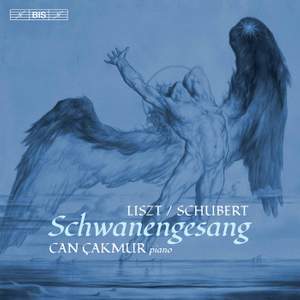
Special offer. Franz Liszt: Schwanengesang & Quatre Valses oubliees

Can Çakmur (piano)

Franz Liszt: Schwanengesang & Quatre Valses oubliees
Even with center-of-the-repertoire material, performances of this level would merit an enthusiastic appreciation; with repertoire of this rarity, they’re doubly welcome. Add BIS’s warm and realistic...

Special offer. Franz Liszt: Schwanengesang & Quatre Valses oubliees

Can Çakmur (piano)

Purchase product

SACD

Hybrid Multi-channel

Original price $17.75 Reduced price $14.20

1 available: usually despatched in 3 - 4 working days

Stream now Hi-RES 96 kHz, 24 bit
Even with center-of-the-repertoire material, performances of this level would merit an enthusiastic appreciation; with repertoire of this rarity, they’re doubly welcome. Add BIS’s warm and realistic...

About

Franz Liszt’s arrangement of Schubert’s Schwanengesang is very much his own work: while it very clearly retains the musical meaning of the original it also provides a vision of Liszt’s understanding of what lies beyond the black dots on paper. In the young Turkish pianist Can Çakmur’s words, Liszt’s ‘songs without words’ are ‘striking, horrifying, grand, intimate, full of life and yet often as pale as death. The marvel of what a single instrument can attain plays an integral role in all these pieces.’ Published posthumously, Schwanengesang is a collection of songs that Schubert may have intended to be grouped together, but if so he never provided a definitive order. In his arrangement, Liszt adopted an order of his own, and Çakmur takes the same liberty, seeking ‘to arrive at a sequence which presents not a storyline but an emotional journey. The Liszt arrangement was first published in 1840, twelve years after Schubert’s death, and Çakmur contrasts it here with the much later ‘forgotten’ waltzes, Quatre Valses oubliées. As most of Liszt’s late music they are elusive, and Çakmur describes them as ‘possibly wistful, sardonic or melancholic – or perhaps all at once.’ Winner of the 2018 Hamamatsu International Piano Competition, Can Çakmur released his début disc in 2019, receiving praise for his technical prowess and sensibility alike – qualities that come well in hand for his new Liszt recital.

Contents and tracklist

No. 10, Liebesbotschaft
Track length3:30
No. 14, Kriegers Ahnung
Track length6:19
No. 8, Ihr Bild
Track length2:43
No. 9, Frühlingssehnsucht
Track length2:32
No. 5, Abschied
Track length5:32
No. 6, In der Ferne
Track length6:41
No. 7, Ständchen
Track length5:57
No. 11, Der Atlas
Track length2:44
No. 2, Das Fischermädchen
Track length3:29
No. 4, Am Meer
Track length4:10
No. 3, Aufenthalt
Track length3:18
No. 1, Die Stadt
Track length2:51
No. 12, Der Doppelgänger
Track length4:34
No. 13, Die Taubenpost
Track length5:21
No. 1,
Track length3:27
No. 2,
Track length7:03
No. 3,
Track length5:45
No. 4,
Track length4:07

Awards and reviews

May/June 2021

Even with center-of-the-repertoire material, performances of this level would merit an enthusiastic appreciation; with repertoire of this rarity, they’re doubly welcome. Add BIS’s warm and realistic SACD sound (especially effective with the sensitive improvement offered by the surround tracks) and the pianist’s own intelligent notes, and you have a strong addition to the catalog.

December 2020

This new disc presents his bona fides as a Liszt interpreter, and they are impressive...Given the wealth and range of his musical imagination, not to mention his genuine pianistic gifts, I believe Can Çakmur is someone from whom we can confidently and happily expect to hear a great deal more.

March 2021

The result is music that captures all the radiance of ‘Liebesotschaft’, plus the cloudier, more menacing regions of ‘Der Atlas’ and ‘Am Meer’. All this is conveyed in playing where a technique as superlative as it is unobtrusive exists to express the deepest sense of poetry. This is an album to haunt the mind and imagination, and it is perfectly recorded.
View download progress