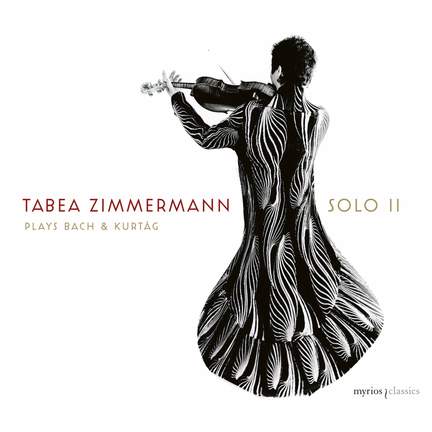
Special offer. Tabea Zimmermann Solo II
Bach & Kurtág
Tabea Zimmermann (viola)
Awards:
-
BBC Music Magazine, Christmas 2020, Instrumental Choice

-
BBC Music Magazine Awards, 2021, Shortlisted - Instrumental

-
Gramophone Awards, 2021, Shortlisted - Instrumental

-
Opus Klassik, 2021, Winner - Solo Instrumental Recital (Viola)

Zimmermann’s playing is profoundly thoughtful, leading to flawlessly structured readings...Perhaps most remarkable is Zimmermann’s breathtakingly skilful performance of the Sarabandes in which...
Special offer. Tabea Zimmermann Solo II
Bach & Kurtág
Tabea Zimmermann (viola)
Purchase product

Awards:
-
BBC Music Magazine, Christmas 2020, Instrumental Choice
-
BBC Music Magazine Awards, 2021, Shortlisted - Instrumental
-
Gramophone Awards, 2021, Shortlisted - Instrumental
-
Opus Klassik, 2021, Winner - Solo Instrumental Recital (Viola)
Zimmermann’s playing is profoundly thoughtful, leading to flawlessly structured readings...Perhaps most remarkable is Zimmermann’s breathtakingly skilful performance of the Sarabandes in which...
About
Ten years after her acclaimed album Solo with the first two cello suites of Johann Sebastian Bach, violist Tabea Zimmermann now sets her sights on Suites Nos. 3 and 4. She pairs them with excerpts from György Kurtág's cycle Games, Signs & Messages , selecting six numbers to form her own personal homage to Bach.
For what kind of instruments did Bach write his solo suites BWV 1007-1012? How did they sound, what did they look like? This subject still gives rise to much speculation. Johann Peter Kellner's manuscript copy from the early 1700s is one of the two main sources for the six solo suites, and it indicates a viola basso. The violoncello had not yet become standardized in terms of size, construction, and playing technique; Bach probably had instruments in mind such as the violoncello piccolo or the viola da spalla.The latter was a viola attached in front of the body by a strap: Bach performed the viola da spalla in public himself possibly these suites. Tabea Zimmermann has not switched her musical hardware for this recording: here she plays her 1980 Vatelot viola with a classical bow.
In 2009, the album Solo (MYR003) launched Tabea Zimmermann's collaboration with the myrios classics label. The release was crowned with a multitude of international awards: Gramophone Editor's Choice, Stern des Monats in Fono Forum, 4f in Télérama and 5 Stars in the Italian magazine Musica; moreover, in response to that groundbreaking recording, the jury of the coveted German ECHO Klassik Prize selected Tabea Zimmermann as 2010 Instrumentalist of the Year.
Contents and tracklist
Awards and reviews
-
BBC Music MagazineChristmas 2020Instrumental Choice
-
Opus Klassik2021Winner - Solo Instrumental Recital (Viola)
 Christmas 2020
Zimmermann’s playing is profoundly thoughtful, leading to flawlessly structured readings...Perhaps most remarkable is Zimmermann’s breathtakingly skilful performance of the Sarabandes in which the differentiation of detail within a contrapuntal texture sounds almost as if two instruments are playing...Superbly recorded in a richly resonant ambience, this is an unusual and compelling release.
 December 2020
[The Kurtág pieces] are powerfully direct in expression while displaying the greatest compositional skill and subtlety...As for her Bach, it is a joy. I sometimes wonder if these suites work better on the viola than they do on the cello, so much do they gain in lightness and agility. Certainly in Zimmermann’s hands they are airborne, free to race and play, dance with nimble feet or graceful swings, and sing with clean, sweetly floated line.
 26th September 2020
Using a classical bow, light and swift for clear articulation, she nevertheless plays a modern viola, her 1980 instrument made by the celebrated French luthier Étienne Vatelot. Its rich, even sound is given maximum bloom in this spacious recording.
 8th October 2020
It comes as a revelation to hear Bach’s cello suites performed on a viola by this great German musician, Tabea Zimmermann. Here they have a dynamism never achieved on the cello, and her playing has a wonderful eagerness and persuasiveness. But the six works by the enigmatic Gyorgy Kurtag – who devotedly plays Bach on the piano - are no less of a revelation: with the shortest lasting just 45 seconds and three just over one minute, their grouping (by Zimmerman) into a suite to echo Bach’s six-movement works creates a brand-new sound-world.