

Help
Skip to main content

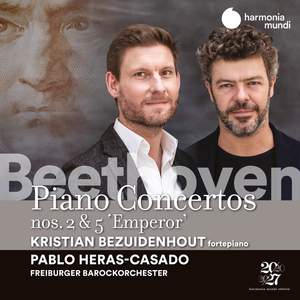
Beethoven: Piano Concertos Nos. 2 & 5

Kristian Bezuidenhout (fortepiano), Freiburger Barockorchester, Pablo Heras-Casado

Beethoven: Piano Concertos Nos. 2 & 5

Awards:

These are invigorating performances of Beethoven’s first and last concertos, conveying an admirable sense of spontaneity…The entire performance [of No. 2] radiates energy and enjoyment… Bezuidenhout...

Beethoven: Piano Concertos Nos. 2 & 5

Kristian Bezuidenhout (fortepiano), Freiburger Barockorchester, Pablo Heras-Casado

Purchase product

CD

$14.75

2 in stock: usually despatched within 1 working day

Download

From$11.50

Download

Audio formats guide

96 kHz, 24 bit, FLAC/ALAC/WAV

$17.25

44.1 kHz, 16 bit, FLAC/ALAC/WAV

$13.75

320 kbps, MP3

$11.50

This release includes a digital booklet

Stream now Hi-RES 96 kHz, 24 bit

Awards:

These are invigorating performances of Beethoven’s first and last concertos, conveying an admirable sense of spontaneity…The entire performance [of No. 2] radiates energy and enjoyment… Bezuidenhout...

About

Beethoven's five piano concertos relate, in a sense, part of the composers life: some twenty years during which a young musician from Bonn made several revised versions of the first concerto he wrote (a springboard to Viennese success that ended up being called no.2), before becoming the familiar Emperor of music embodied by the brilliant inspiration of no.5. Two hundred and fifty years after his birth, it is with these two extremes that Kristian Bezuidenhout, Pablo Heras-Casado and the Freiburger Barockorchester have chosen to start an exciting period-instrument trilogy of the concertos that bids fair to be a landmark!

Contents and tracklist

I. Allegro
Track length19:40
This track is only available as an album download.
II. Adagio un poco mosso
Track length6:34
III. Rondo. Allegro
Track length10:12
I. Allegro con brio
Track length13:38
II. Adagio
Track length7:33
III. Rondo. Molto allegro
Track length5:47

Spotlight on this release

Awards and reviews

  • Record Review
    15th February 2020
    Record of the Week
  • BBC Music Magazine
    April 2020
    Concerto Choice
  • Opus Klassik Awards
    2020
    Nominee - Conductor of the Year
  • Opus Klassik Awards
    2020
    Nominee - Instrumentalist of the Year  
  • Gramophone Magazine
    Critics' Choice 2020

April 2020

These are invigorating performances of Beethoven’s first and last concertos, conveying an admirable sense of spontaneity…The entire performance [of No. 2] radiates energy and enjoyment… Bezuidenhout treats the flourishes at the beginning of the Emperor Concerto with a good deal of freedom, lending them an appropriately improvisatory feel…This really is exciting playing, and Bezuidenhout’s virtuosity is impressive.

Jul/Aug 2020

the performance of the Second Concerto is quite brilliantly conceived and executed…the finale brings a smile to the face immediately, and the overall performance is ultimately exhilarating. As it stands, I believe that this new recording is now a clear first choice for period-instrument performance.

March 2020

One of the choicest offerings thus far this celebratory Beethoven year...Bezuidenhout has a long, fruitful relationship with Freiburg...Add to the mix the lively imagination of Heras-Casado, the Freiburgers playing their hearts out, plus expert sound as clean as you’re likely to come across in 2020, and you have the makings of a hot recording.

July 2020

Thanks to his artistry – and to excellent support from the Freiburger Barockorchester and Pablo Heras-Casado – there are moments which will convince even those listeners most wedded to modern instruments.

26th January 2020

[Bezuidenhout’s] performance of the Emperor concerto is scintillatingly dramatic, heroic, deftly articulated and, above all, fresh; and the instrument he plays seems to possess plenty of power. The Second Concerto is given equally enticingly...both readings are enhanced by the brilliantly coloured playing of the Freiburgers under Pablo Heras-Casado.

20th February 2020

[Bezuidenhout] and Heras-Casado have thought deeply about how best to make these pieces sing. He plays on a copy of an 1824 Conrad Graf fortepiano, which sounds both perky and soft-edged, with a slight woodiness allied to an almost bell-like clarity...The orchestra can be almost boisterous, but the piano tempers it with a raised eyebrow, or with its sheer charm...But what marks this recording out is the way they make the music dance – as if no one is watching.
View download progress