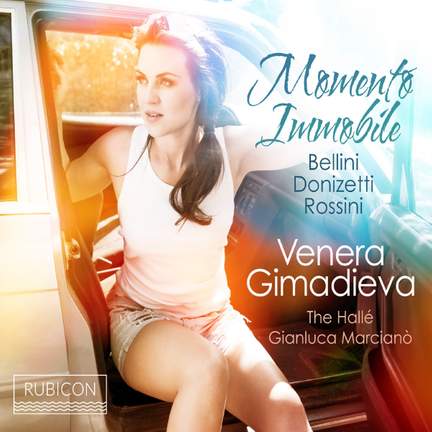
Momento immobile
Bel canto arias by Bellini, Donizetti and Rossini
Venera Gimadieva (soprano)
The Hallè, Gianluca Marciano
Gimadieva tackles the coloratura with dexterity, presenting characterful interpretations throughout…The Hallé, conducted by Gianluca Marcianò, are sympathetic collaborators throughout, upping...
Momento immobile
Bel canto arias by Bellini, Donizetti and Rossini
Venera Gimadieva (soprano)
The Hallè, Gianluca Marciano
Purchase product

Gimadieva tackles the coloratura with dexterity, presenting characterful interpretations throughout…The Hallé, conducted by Gianluca Marcianò, are sympathetic collaborators throughout, upping...
About
Hailed as ‘the new voice of Russia’ and the star of the Bolshoi Theatre in Moscow, Venera Gimadieva has quickly become one of the most sought-after lyric coloratura sopranos in Europe. Her performances as Violetta in La Traviata have earned sensational reviews, with the Guardian describing her at her Glyndebourne Festival debut as “a soprano of huge presence, compelling to watch, with a voice of thrilling security and range, and a special quality to her quieter singing that makes you hang on every note.”
Bel canto opera is a plethora of paradoxes and these are most powerfully embodied by the prima donna herself. Pure and passionate, alluring and alarming, desirable and dangerous, she is a woman who, driven by uncontainable desire or righteousness, defies or disregards social convention in her search for what might be deemed a more modern form of self-expression and freedom. She articulates a luxurious femininity which sonically embodies the female form, and is both emancipatory and intimidating. Undeniably, powerfully sensual, she was – and is – subject to patriarchal and social control; innocent, spiritual and soulful, she suffers, is sick and must be destroyed. The melismatic madness of the heroine speaks of a ‘mania’ that is not alien to contemporary notions of a neurosis afflicting modern woman. Does her vocal intensity make us idealise her, or crave and command her sacrifice? At the start of the 21st century, do we recognise her voice as our own? Or is at, as Michel Poizat has argued, ‘the angel’s cry’, an inarticulate expression of the soul at both the pinnacle of its power and the moment of death: a momento immobile.
Contents and tracklist
- Venera Gimadieva (soloist)
- Hallé Orchestra
- Gianluca Marciano
- Venera Gimadieva (soloist)
- Hallé Orchestra
- Gianluca Marciano
- Venera Gimadieva (soloist), Natalia Brzezinska (soloist)
- Hallé Orchestra
- Gianluca Marciano
- Venera Gimadieva (soloist)
- Hallé Orchestra
- Gianluca Marciano
- Venera Gimadieva (soloist), Natalia Brzezinska (soloist)
- Hallé Orchestra
- Gianluca Marciano
- Venera Gimadieva (soloist)
- Hallé Orchestra
- Gianluca Marciano
- Venera Gimadieva (soloist)
- Hallé Orchestra
- Gianluca Marciano
- Venera Gimadieva (soloist), Natalia Brzezinska (soloist), Alberto Sousa (soloist)
- Hallé Orchestra
- Gianluca Marciano
- Venera Gimadieva (soloist)
- Hallé Orchestra
- Gianluca Marciano
- Venera Gimadieva (soloist)
- Hallé Orchestra
- Gianluca Marciano
Spotlight on this release
-
An error occurred.
Try watching this video on www.youtube.com, or enable JavaScript if it is disabled in your browser.
Awards and reviews
 January 2019
Gimadieva tackles the coloratura with dexterity, presenting characterful interpretations throughout…The Hallé, conducted by Gianluca Marcianò, are sympathetic collaborators throughout, upping the ante during an enjoyable ‘Willow Song’.
 March 2019
The big scene from the last act of Rossini’s Otello, ending with the Willow Song, is one of her finest dramatic portrayals…She also gives a poised account of ‘Sombre forêt’ (Guillaume Tell), exhibiting skilful management of the ornaments. Elsewhere there are limitations in terms of colouring and dynamic variety, while her often edgy tone is not always an easy listen, particularly higher up.