

Bruckner: Symphony No. 3 in D minor ‘Wagner Symphony'
Philharmonie Festiva, Gerd Schaller
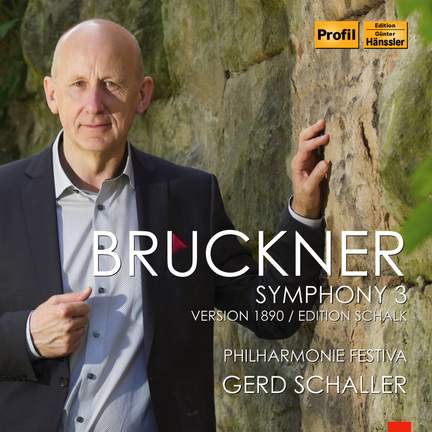
Schaller knows how to sustain the listener’s interest while maintain fidelity to the score, and how to encourage refined and sonorous playing from the orchestra…Profil’s recording offers excellent...
Bruckner: Symphony No. 3 in D minor ‘Wagner Symphony'
Philharmonie Festiva, Gerd Schaller
Purchase product

We pay more royalties to artists and composers than any other streaming service with our innovative Fair Play pay-per-second model
We pay artists and composers fairly with our pay-per-second model
Schaller knows how to sustain the listener’s interest while maintain fidelity to the score, and how to encourage refined and sonorous playing from the orchestra…Profil’s recording offers excellent...
About
Immediately after completing the Second Symphony, Anton Bruckner (1824 – 1896) continued a fruitful compositional spree by starting the draft of his Third. He had no way of knowing then that this work would continue to occupy him for the rest of his life. The Third is written in D minor, just like the early symphony that was not assigned a number and labelled as 'nullified' in the composer's autograph. Bruckner spent more time working on the Third than on any other symphony. His efforts yielded three versions that are now widely performed: the 1873 version, the 1877 version and the 1888/89 version.' (Excerpt from the booklet notes written by Gerd Schaller)
Contents and tracklist
Work length57:21
This work is only available as an album download.
- Philharmonie Festiva
- Gerd Schaller
- Recorded: 23th September 2017
- Recording Venue: Abteikirche Ebrach, Germany
Symphony No. 3 in D Minor, WAB 103 (1890 Version, Ed. T. Raettig): I. Mäßig bewegt
Track length20:45
This track is only available as an album download.
Symphony No. 3 in D Minor, WAB 103 (1890 Version, Ed. T. Raettig): II. Adagio, quasi andante
Track length14:28
Symphony No. 3 in D Minor, WAB 103 (1890 Version, Ed. T. Raettig): III. Scherzo. Ziemlich schnell
Track length7:46
Awards and reviews
 July 2018
Schaller knows how to sustain the listener’s interest while maintain fidelity to the score, and how to encourage refined and sonorous playing from the orchestra…Profil’s recording offers excellent sound, presenting the orchestra with an attractive sheen and allowing textural detail to be clearly heard despite the six-second reverberation of Ebrach Abbey.
