Special offer. Borodin: Piano Quintet & String Quartet No. 2
Piers Lane (piano), Julian Smiles (cello)
Goldner String Quartet
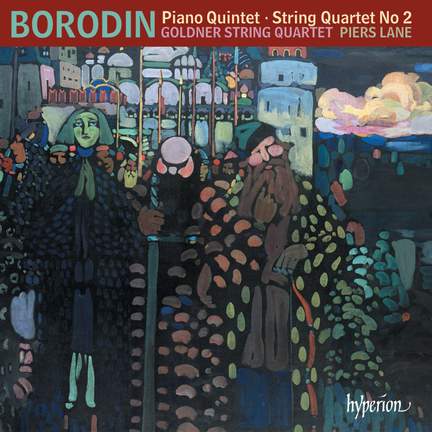
This is a glowing performance of the Quartet No. 2…the quartet’s playing is consistently fine.
Special offer. Borodin: Piano Quintet & String Quartet No. 2
Piers Lane (piano), Julian Smiles (cello)
Goldner String Quartet
Purchase product

We pay more royalties to artists and composers than any other streaming service with our innovative Fair Play pay-per-second model
We pay artists and composers fairly with our pay-per-second model
This is a glowing performance of the Quartet No. 2…the quartet’s playing is consistently fine.
About
Russia in the nineteenth century had little need for chamber music—no Parisian-style competitive quartetting here. But out of this very isolation came a small, but nonetheless mighty, handful of works: those by Borodin are among the finest. Piers Lane and the Goldner String Quartet revel in what they find.
Contents and tracklist
Spotlight on this release
-
An error occurred.
Try watching this video on www.youtube.com, or enable JavaScript if it is disabled in your browser.
Awards and reviews
 May 2017
This is a glowing performance of the Quartet No. 2…the quartet’s playing is consistently fine.
 March 2017
[Second Quartet] a work of maturity and one the Goldners interpret with a winning lyrical touch, well projected energy and an instinctive feel for the musical language.
 26th February 2017
The Piano Quintet (1862), with its very Russian five-bar opening theme, is engaging and skilfully crafted, even if it can’t compare with Brahms’s or Schumann’s, and Piers Lane and the excellent Goldners make the most of it, as they do of the attractively tuneful second quartet.
 19th March 2017
finely crafted quartet, elegantly played here by the Goldners. Their fellow Australian Piers Lane joins them for the handsome Piano Quintet in C minor from 1862, and features again with the fluent Julian Smiles for the Cello Sonata in B minor, incomplete until 1982 when Mikhail Goldstein made this engaging reconstruction.
 May 2017
The Goldner’s playing opens up appropriately: there’s plenty of warmth in the players’ tone, singly and collectively, and the work’s emotions – notably in the Notturno – are laid bare without being over-egged. There’s also some seriously stylish playing in the faster music, with delightful interplay between all four instruments in the finales.
classicalsource.com April 2017
there is no doubting the splendid music-making or tangible recording. This release is then a timely showcase for a composer who was a professional chemist with experience as a surgeon and who dabbled in science, and who founded the School of Medicine for Women in St Petersburg; he may have been a part-time musician but he bequeathed us some skilled and distinctive creations.
Classical Ear 20th March 2017
A generous Borodin chamber triptych comprising two youthful offerings and a bona fide masterpiece…When it comes to the 1881 Second String Quartet, of course, we're in the presence of heaven-sent genius – a wholly mature utterance that never fails to captivate in its indelible melodic fecundity, exquisite craftsmanship and vernal freshness of inspiration. The Goldners do it justice in a reading of considerable discernment, infectious spontaneity and palpable affection