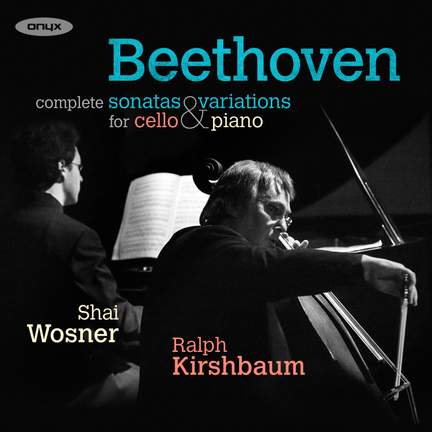
Beethoven: Cello Sonatas Nos. 1-5 and variations
Ralph Kirschbaum (cello) & Shai Wosner (piano)
Awards:
-
BBC Music Magazine, April 2017, Chamber Choice

sometimes it's like listening to two people excitedly bouncing ideas off each other; at others it's like a love duet, or even the kind of intense parting conversation in which every word counts...
Beethoven: Cello Sonatas Nos. 1-5 and variations
Ralph Kirschbaum (cello) & Shai Wosner (piano)
Purchase product

Awards:
-
BBC Music Magazine, April 2017, Chamber Choice
sometimes it's like listening to two people excitedly bouncing ideas off each other; at others it's like a love duet, or even the kind of intense parting conversation in which every word counts...
About
Beethoven’s sonatas for cello and piano span his entire creative life. The Op.5 sonatas date from the late 1790s and therefore are products of his early years as a virtuoso pianist and aspiring composer in Vienna, where he had settled after leaving his native Bonn.
The 3rd sonata Op.69 dates from the composer’s ‘middle period’, and is contemporary with the 4th and 5th Symphonies and the Razumovsky String Quartets. It is one of his greatest chamber compositions, a work of great beauty, full of surprises and seemingly limitless inventiveness.
The two sonatas of Op102 were composed at the beginning of Beethoven’s visionary ‘late period’ and rub shoulders with the last violin sonata, the piano sonatas Nos.27, 28 and 29 ’Hammerklavier’. Beethoven’s later fascination with the baroque fugue surfaces not only at the end of the ‘Hammerklavier’ but also in the finale of the 5th sonata, reaching its apex in the Grosse Fugue’ Op.133 a few years later.
These performances were recorded immediately after live performances at Wigmore Hall, the culmination of a tour of all 5 Sonatas and the Variations across the USA and the UK in conjunction with Texas-born, Ralph Kirschbaum's 70th birthday.
Contents and tracklist
Awards and reviews
-
BBC Music MagazineApril 2017Chamber Choice
 April 2017
sometimes it's like listening to two people excitedly bouncing ideas off each other; at others it's like a love duet, or even the kind of intense parting conversation in which every word counts to an almost painful degree…few get so close to the complex truth of this music
 Febuary 2017
[these sonatas] have an infectious exuberance. Highlights are many: the opening movement of Op 102 No 1, for instance, which is unerringly paced and nicely balances the muscular and the skittish, and Kirshbaum never less than beautiful in the high-lying writing…as a whole, this is a more ‘traditional’ approach to the sonatas than the comparisons listed below, but if subversion and reinvention are not top priorities, it’s well worth exploring
 8th December 2016
Wosner keeps the piano line crisp and buoyant; Kirshbaum spins long, broad phrases that look convincingly into the far distance. Together they make Beethoven’s huge structures work, but the details can be striking too.
 10th January 2017
The playing is probing yet unaffected, thoughtful yet delivered with a simplicity that lets Beethoven’s lyrical succinctness shine through the maelstrom of emotions that flavour the sonatas’ expressive twists and turns…Kirshbaum brings effortless maturity to all these works, supported by the poetic solidity of Wosner’s pianism
 20th February 2017
It is the rugged, Romantic side of Beethoven that is to the fore in these interpretations. Pure and precise they may not always be...but they are full of authentic feeling.