Bartók: 44 Duos for Two Violins, BB 104, Sz. 98
Deborah Nemtanu (violin) & Sarah Nemtanu (violin)
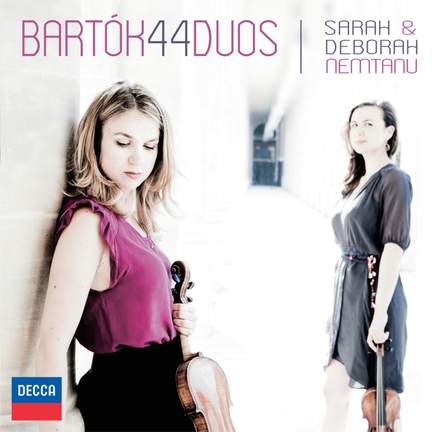
[Sarah and Deborah Nemtanu] play all these pieces to the manner born, and are particularly impressive in the Arab-inflected dances, which they dispatch with fiery freedom
Bartók: 44 Duos for Two Violins, BB 104, Sz. 98
Deborah Nemtanu (violin) & Sarah Nemtanu (violin)
Purchase product

[Sarah and Deborah Nemtanu] play all these pieces to the manner born, and are particularly impressive in the Arab-inflected dances, which they dispatch with fiery freedom
About
Romanian-born sisters Sarah and Deborah Nemtanu form a violin-playing dynasty: Sarah has been leader of the Orchestre National de France since 2001 and Deborah leads the Orchestre de Chambre de Paris. Both began violin studies with their father Vladimir who led the Orchestre National Bordeaux Aquitaine.
The Nemtanu Sisters’ Romanian blood makes them the perfect, idiomatic interpreters of Bartok’s 44 Duos: all the songs and dances are based on folk music from many Eastern Europe countries. The harmonic and rhythmic freedom demanded by the music is second nature to them, as demonstrated in the notable track: [38] Forgatós: ‘Romanian Whirling Song’.
No strangers to the recording studio, the sisters have previously recorded the Bach Double Concerto to critical acclaim. Norman Lebrecht chose it as a Disc of the week on Sinfini Music: “Their musical dialogue is full of fascination, alternately confrontational and playful, challenging and interactive.”
Contents and tracklist
- Sarah Nemtanu (violin), Déborah Nemtanu (violin)
- Recorded: 2015-06-28
- Recording Venue: Babel Studios, Paris
Spotlight on this release
-
An error occurred.
Try watching this video on www.youtube.com, or enable JavaScript if it is disabled in your browser.
Awards and reviews
 June 2016
[Sarah and Deborah Nemtanu] play all these pieces to the manner born, and are particularly impressive in the Arab-inflected dances, which they dispatch with fiery freedom
 March 2016
the Nemtanu sisters leave a strong impression: you can happily listen to them at a single stretch and their playing is captured in very well-balanced sound
 14th January 2016
They are both fiery players and they egg each other on in sparky, intuitive exchanges, but they’re used to making big, glossy solo sounds, which swamp the simpler pieces. Their best moments come when they’re at their most introspective: the sombre Wedding Song (Number 13) or the strange, sinewy New Year’s Greeting (Number 21).