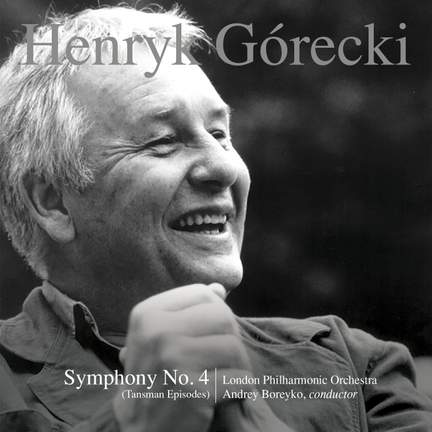
Gorecki: Symphony No. 4
London Philharmonic Orchestra, Andrey Boreyko
Awards:
-
Presto Recording of the Week, 22nd January 2016

[the symphony] opens with brutal, relentless chords, disconcerting pauses and Kancheli-like violent dynamic contrasts. There's a degree of relief in gentle passages in intervening movements...
Gorecki: Symphony No. 4
London Philharmonic Orchestra, Andrey Boreyko
Purchase product

Awards:
-
Presto Recording of the Week, 22nd January 2016
[the symphony] opens with brutal, relentless chords, disconcerting pauses and Kancheli-like violent dynamic contrasts. There's a degree of relief in gentle passages in intervening movements...
About
The recording of the late Henryk Górecki’s final composition, Symphony No. 4, Tansman Episodes, was made during the 2014 world premiere performance at London’s Royal Festival Hall with co-commissioner London Philharmonic Orchestra conducted by Andrey Boreyko.
The piece, which pays homage to Górecki’s fellow Polish composer Alexsander Tansman, was incomplete at the time of Górecki’s 2010 death and thus missed its previously scheduled premiere. However the score had precise indications for orchestration, which Górecki’s son Mikolaj, also a composer, used to complete it. The Daily Telegraph said the piece ‘caps Górecki's reputation as an orchestral composer, but it also contains some surprises. The music features some brutal juxtapositions of massively powerful music with slow, intimate passages for solo instruments, including prominent parts for piano and organ.’
Symphony No. 4 will be released individually and as part of a seven-disc box set, A Nonesuch Retrospective, containing all Nonesuch recordings of Górecki works – Lerchenmusik; Symphony No. 3; String Quartets Nos. 1, 2, and 3; Miserere; Kleines Requiem für eine Polka; Harpsichord Concerto; and Good Night. The first vinyl LP of the beloved 1992 Nonesuch recording of Górecki’s Symphony No. 3 also will be released on October 16.
Born in 1933, Henryk Górecki spent most of his life in southern Poland. He was a leading composer of the Polish avant-garde in the 1950s and later reached a worldwide audience in the 1990s thanks to the success of his Symphony No. 3. The work was composed in 1976, and was at that time shocking in its tonality and simplicity, but it was with the release of the 1992 Nonesuch recording of the piece, featuring Dawn Upshaw and the London Sinfonietta, that it attracted international attention, selling more than a million copies and climbing to the top of the classical music charts in both the US and the UK, where it is certified Platinum. On the unexpected popularity of the piece, the composer remarked, “Perhaps people find something they need in this piece of music... somehow I hit the right note, something they were missing. Something somewhere had been lost to them. I feel that I instinctively knew what they needed.”
The London Philharmonic Orchestra was founded in 1932 by Sir Thomas Beecham. Since then, its principal conductors have included Sir Adrian Boult, Sir Georg Solti, Klaus Tennstedt, and Kurt Masur. In 2007, Vladimir Jurowski became the Orchestra’s principal conductor. The London Philharmonic Orchestra has been performing at Southbank Centre’s Royal Festival Hall since it opened in 1951, becoming resident orchestra in 1992. It also has residencies in Brighton and Eastbourne, and performs regularly around the UK. The Orchestra frequently tours abroad: highlights of the 2014–15 season included appearances across Europe, including Iceland, and tours to the USA (West and East Coasts), Canada, and China. The Orchestra broadcasts regularly on television and radio, and has recorded soundtracks for numerous films including The Lord of the Rings. In 2005 it began releasing live, studio, and archive recordings on its own label.
Symphony No. 4 received its US premiere in January of this year, by co-commissioner Los Angeles Philharmonic, and was performed in February by the Netherlands Radio Philharmonic Orchestra at the Concertgebouw (which is home to the piece’s third co-commissioner, the Zaterdag Matinee concert series). This recording was supported by the Adam Mickiewicz Institute as part of the Polska Music programme.
Contents and tracklist
- Henryk Górecki, London Philharmonic Orchestra
- Andrey Boreyko
Spotlight on this release
-
An error occurred.
Try watching this video on www.youtube.com, or enable JavaScript if it is disabled in your browser.
-
Henryk Górecki's Symphony No. 4
22nd Jan 2016
David listens to the world-premiere recording of Henryk Górecki's fourth and final symphony, with Andrey Boreyko and the London Philharmonic Orchestra.

Awards and reviews
-
Presto Recording of the Week22nd January 2016
 December 2015
[the symphony] opens with brutal, relentless chords, disconcerting pauses and Kancheli-like violent dynamic contrasts. There's a degree of relief in gentle passages in intervening movements but the finale's folk-influenced dance-music is expelled by a return of the dark, discordant, forbidding material. Under Andrey Boreyko's sober control the LPO negotiates these contrasts with aplomb.
 February 2016
[this symphony] stands as an impressive musical mausoleum to the many elements that comprised Gorecki's own language - a powerful and personal farewell from one of the 20th century's most distinctive voices
 22nd January 2016
With his Fourth Symphony it feels as if Górecki is decisively drawing a line under the “holy minimalist” sound of the Third; right from the beginning the sound-world is hard-edged and stern...If Górecki’s cell-based writing seems at times to evoke the workings of some great inorganic mechanism, then Boreyko’s musicians can certainly be described as a well-oiled machine; their ensemble is tight, and the performance as a whole is taut and free of unnecessary sentiment.
 21st February 2016
An interesting curiosity from a surprisingly inscrutable composer.