Objects At An Exhibition
Aurora Orchestra, Nicholas Collon
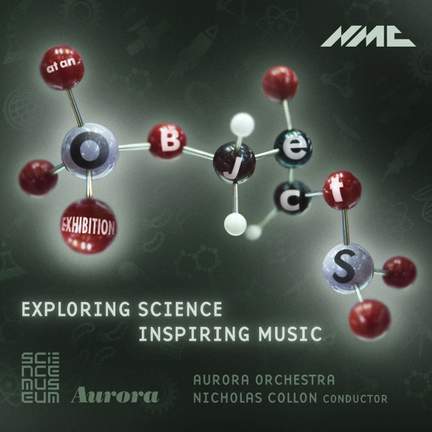
The premise of the Aurora Orchestra's Objects at an Exhibition - to let a gaggle of composers loose in London's Science Museum - has resulted in subtly unpredictable chamber works. No explosions...
Objects At An Exhibition
Aurora Orchestra, Nicholas Collon
Purchase product

The premise of the Aurora Orchestra's Objects at an Exhibition - to let a gaggle of composers loose in London's Science Museum - has resulted in subtly unpredictable chamber works. No explosions...
About
Objects at an Exhibition is a landmark commissioning project by NMC Recordings, in partnership with Aurora Orchestra and the Science Museum 'The most headline-grabbing of a series of recent announcements by NMC [that] aims to increase the audience for contemporary music ... this is an imaginative step on that worthwhile mission' Gramophone
Re-imagining Mussorgsky's Pictures at an Exhibition for the twenty-first century, these six new works, commissioned by NMC Recordings, are inspired by an object or space in London's world-renowned Science Museum. Each composer had free rein to pick an exhibit.
Thea Musgrave was attracted to the impressive Energy Hall with its C18th- C19th steam engines; the result is a playful work for woodwind, brass and strings that conveys the inner workings of the vast machines.
Christopher Mayo's piece for cello, double bass and four samplers is inspired by a slate statue of RJ Mitchell (the designer of the Spitfire) in the Flight Gallery. Samples of aeroplane engines grow from distant drone to hypnotic and cachophonous noise.
The enormous but 'melancholic' quality of 2LO (the first BBC transmitter) was what first caught Claudia Molitor's eye, and after doing some research she discovered that initially the transmission of music was prohibited and only speech was deemed acceptable. She uses BBC Sound Archive recordings from 2LO broadcasts in her piece.
David Sawer's work, with percussion – like strings, woodwind and fl ugel horn, conjures up vivid images of the 1830 York Mail Coach (displayed in the 'Making of the Modern World' gallery) speeding through the streets.
Gerald Barry chose an artificial arm with fingers stretched to play only octaves as inspiration – the prosthetic limb belonged to an unidentified female pianist and Barry's haunting, hypnotic composition continually repeats a two-note phrase which gradually evolves into octaves.
The graphic score hand-drawn and partially coloured by Barry Guy is a work of art in itself. Charles Babbage's Difference Engine and his drawings influenced Guy's piece which unsurprisingly, for a composer/bassist who has worked in free improv groups with Derek Bailey and Evan Parker, calls on spontaneity and improvisation from the 13 musicians of the Aurora Orchestra.
Contents and tracklist
- Aurora Orchestra
- Nicholas Collon
- Recording Venue: Science Museum, London, Great Britain, United Kindom
- Aurora Orchestra
- Nicholas Collon
- Recording Venue: Science Museum, London, Great Britain, United Kindom
- Aurora Orchestra
- Nicholas Collon
- Recording Venue: Science Museum, London, Great Britain, United Kindom
- Aurora Orchestra
- Nicholas Collon
- Recording Venue: Science Museum, London, Great Britain, United Kindom
- Aurora Orchestra
- Nicholas Collon
- Recording Venue: Science Museum, London, Great Britain, United Kindom
- Aurora Orchestra
- Nicholas Collon
- Recording Venue: Science Museum, London, Great Britain, United Kindom
Spotlight on this release
-
An error occurred.
Try watching this video on www.youtube.com, or enable JavaScript if it is disabled in your browser.
Awards and reviews
 January 2016
The premise of the Aurora Orchestra's Objects at an Exhibition - to let a gaggle of composers loose in London's Science Museum - has resulted in subtly unpredictable chamber works. No explosions here, but then the composer choice was judicious...David Sawer's plain choice of a mail coach (Coachman Chronos) yields one tour de force of undeniable mastery: I hope it races on to the concert stage.
 September 2015
Throughout this diverse while cohesive miscellany, the Aurora Orchestra respond with keen virtuosity to Nicholas Collon's alert direction. Vividly recorded, with booklet-notes providing ample context, it is more than just a memento of the live presentation at the Science Museum this October, which promises to be a watershed in the evolution of site-specific performance.