

Help
Skip to main content

US TARIFFS UPDATE | August 2025 | No impact expected on your Presto orders | Read full details

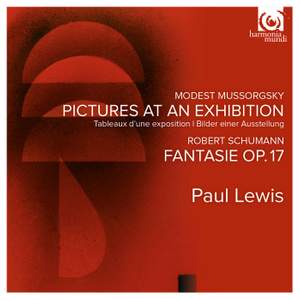
Mussorgsky: Pictures at an Exhibition

Paul Lewis (piano)

Mussorgsky: Pictures at an Exhibition

Awards:

Lewis has a natural empathy for Schumann, revelling in the first movement's impulsive changes of mood and projecting wonderfully calm inner reflection at the outset of the third. He emphasises...

Mussorgsky: Pictures at an Exhibition

Paul Lewis (piano)

Purchase product

CD

$21.25

10+ available: usually despatched in 4 - 5 working days

Download

From$11.00

Download

Audio formats guide

96 kHz, 24 bit, FLAC/ALAC/WAV

$19.25

44.1 kHz, 16 bit, FLAC/ALAC/WAV

$13.75

320 kbps, MP3

$11.00

This release includes a digital booklet

Stream now Hi-RES 96 kHz, 24 bit

Awards:

Lewis has a natural empathy for Schumann, revelling in the first movement's impulsive changes of mood and projecting wonderfully calm inner reflection at the outset of the third. He emphasises...

About

In 1870, the architect, sculptor and painter Viktor Hartmann (born in 1834) was invited by Vladimir Stasov, the most influential Russian art critic of his time, to join the ‘Group of Five’, a St Petersburg-based circle of composers that, in addition to Mussorgsky, included Borodin, Balakirev, Cui, and Rimsky-Korsakov. The members of this ‘Mighty Handful’ had set themselves the spiritual task of establishing a national Russian music free of western influences. Just three years later, in August 1873, Hartmann died of an aneurysm; he was not yet 40. ‘What misfortune! O greatly suffering Russian art!’ wrote the deeply affected Mussorgsky, lamenting the loss of his friend. Along with Stasov, he championed the cause of a memorial exhibition in honour of his intellectual fellow-spirit. Stimulated by this much-admired retrospective, in the spring of 1874, which presented some 400 pictures from different phases of the artist’s creative career, Mussorgsky decided to erect a musical monument to the dead man as well. He threw himself feverishly into the work. When the piano cycle was completed on 22 June 1874, the manuscript bore the inscription: ‘Dedicated to Vladimir Vasilievich Stasov. Pictures at an Exhibition. In Memory of Viktor Hartmann.’ Mussorgsky created here something subtler and more ambivalent than Hartmann’s paintings might suggest. Alongside the dazzling virtuosity they call for, Paul Lewis’s unexpected coupling reveals the purely musical qualities of these two 19th-century masterpieces.

Contents and tracklist

Promenade. I. The gnome
Track length3:53
Promenade. II. The old castle
Track length5:18
Promenade. III. The Tuileries Gardens (Children quarrelling after playing)
Track length1:27
IV. Bydlo.
Track length3:00
Promenade. V. Ballet of the unhatched chicks
Track length1:49
VI. "Samuel" Goldenberg und "Schmüyle".
Track length2:19
Promenade. VII. The marketplace in Limoges
Track length2:40
VIII. The catacombs
Track length2:21
With the dead in a dead language (Promenade). IX.The hut on fowl's legs (Baba Yaga)
Track length5:19
X. The great gate of Kiev
Track length5:34
I. Durchaus phantastisch und leidenschaftlich vorzutragen
Track length12:18
II. Mäßig. Durchaus energisch
Track length8:10
III. Langsam getragen. Durchweg leise zu halten
Track length10:26

Spotlight on this release

Awards and reviews

April 2015

Lewis has a natural empathy for Schumann, revelling in the first movement's impulsive changes of mood and projecting wonderfully calm inner reflection at the outset of the third. He emphasises the cogency of Mussorgsky's Pictures with a performance of granitic strength and wonderful tonal variety.

March 2015

Lewis has quite a spring in his step, and he emphasises the sense of leading to each Picture by not tracking the Promenades separately...The Schumann (perhaps a strange coupling) has much to recommend it. It is more contained than some; but Lewis's haloed sound and unfailing sense of thoughtfulness is winning.

March 2015

Lewis parades [the Schumann's] heroic gestures in bold style, but he is also dynamically modulated - the music and what it may be about comes first...and his manner in slower sections is seductive if also organically fitting...As for the canvases, Lewis is vivid with them, and his approach is enjoyable and admirable...Lewis's account, overall, is very impressive and recommendable.

1st February 2015

Lewis possesses the palette of pianistic colour and the immediacy of impulse to animate and crystallise the moods of the individual miniatures, coupled with the long view that unites them into a multifaceted but fully integrated whole. The magnificence of his achievement here is replicated in Schumann’s C major Fantasie.

Pianist Magazine April/May 2015

I liked his fearless approach – it is like a young gazelle outrunning its competitors … Lewis brings his beautiful singing tone to the tender last movement [of the Schumann].

6th February 2015

His directness of approach is heightened by the in-your-face closeness of the recorded sound…the resulting rawness highlights the originality of the music.
View download progress