Special offer. J L Dussek: Piano Music
Vincenzo Paolini (piano)
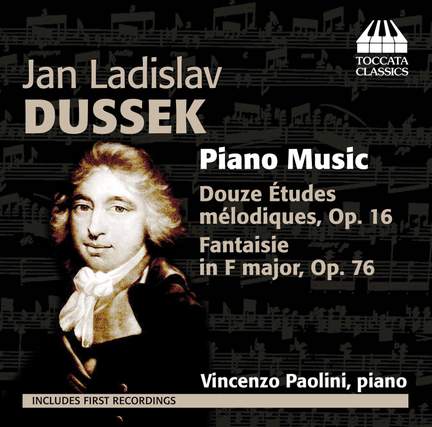
Dussek’s oeuvre well deserves disinterring. For all its seeming looseness the Fantaisie is harmonically diverting and has an attractive freedom of expression, whilst the Études can’t help providing...
Special offer. J L Dussek: Piano Music
Vincenzo Paolini (piano)
Purchase product

Dussek’s oeuvre well deserves disinterring. For all its seeming looseness the Fantaisie is harmonically diverting and has an attractive freedom of expression, whilst the Études can’t help providing...
About
The compositions of the Czech-born Jan Ladislav Dussek (1760–1812) show the Classical style gradually taking on the expressive characteristics of Romanticism, foreshadowing composers like Beethoven, Chopin, Schubert and Schumann.
The Douze Études mélodiques – here receiving their first recording – offer a sort of musical United Nations of the day, its Polish, Russian, Scottish, Spanish, Turkish and other national elements intended to appeal to the contemporary fashion for the exotic. Dussek’s F major Fantaisie is in effect an eight-movement suite, presenting an array of musical forms and capturing the improvisatory spirit and harmonic exploration of the fantasia.
The scholarly booklet notes, by Rohan Stewart-McDonald, joint editor of Jan Ladislav Dussek (1760–1812): A Bohemian Composer ‘en voyage’ through Europe, are illustrated by six music examples.
Vincenzo Paolini was born in Loreto, Italy in 1979 and studied with Giuseppe Di Chiara at the Conservatorio G. Rossini in Pesaro, graduating with honours. He took a degree in music at the Conservatorio G. B. Pergolesi in Fermo with Enrico Belli. He went on to achieve a Masters in piano and Romantic piano at the Academia Incontri con Maestro in Imola, under the tutelage of Stefano Fiuzzi, and perfected his skills in master-classes with Pierre-Laurent Aimard, Lazar Berman, Cristina Ortiz and Piero Rattalino. This is his first recording for Toccata Classics.
Contents and tracklist
- Vincenzo Paolini
- Vincenzo Paolini
Awards and reviews
 February 2015
Dussek’s oeuvre well deserves disinterring. For all its seeming looseness the Fantaisie is harmonically diverting and has an attractive freedom of expression, whilst the Études can’t help providing entertainment.