Pergolesi: La Serva Padrona, Salve Regina
Federico Benetti (bass), Angela Nisi (soprano)
I Solisti Liriensi, Flavio Emilio Scogna
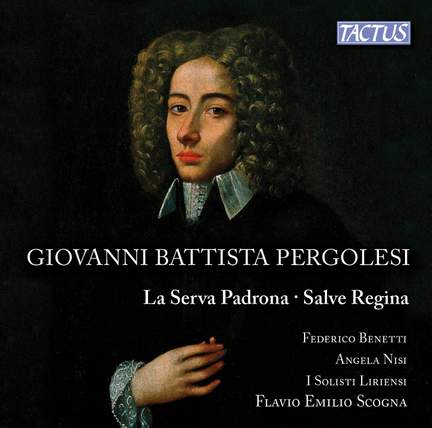
Pergolesi: La Serva Padrona, Salve Regina
Federico Benetti (bass), Angela Nisi (soprano)
I Solisti Liriensi, Flavio Emilio Scogna
Purchase product

About
Flavio Emilio Scogna’s decision to include both La serva padrona and Salve Regina in it was a brilliant choice. Why should we be surprised at the fact that Pergolesi composed always the same music, no matter whether it was an intermezzo, a serious opera or a piece meant to accompany a religious ceremony? This is precisely why he was appreciated. He brought the theatre into churches, and religious seriousness into theatres, even in an intermezzo: A Serpina penserete is a beautiful lament that might well be sung by the Virgin Mary (speaking of laments sung by the Virgin Mary, Monteverdi transformed Ariadne’s lament precisely into the Virgin Mary’s lament). Pergolesi is also the first musician who was never dropped from the repertory, either in theatres or in churches. Before him, only contemporary music was played and sung. His Stabat Mater and La serva padrona never stopped being performed, admired and applauded. They were so appreciated, actually, that many pieces which were not by Pergolesi circulated under his name, because this was enough to ensure that they would be liked. In France La Serva Padrona started a famous quérelle: this work was defended from the criticisms of the traditionalists, Rameau’s followers, by Rousseau himself, and he in turn was supported by all the philosophes, headed by Diderot. That was modern music, they declared. And they were right: drama had stopped being based on stock characters, types and stilted heroes, models of “affetti” or what we might now call universal sentiments. The characters were now men and women who were made of flesh and blood, and had the same feelings and intentions as the men and women who came to the theatre to watch them. Pergolesi’s modernity consists in this. It is still surprising now.
Contents and tracklist
- Federico Benetti, Angela Nisi
- I Solisti Liriensi
- Flavio Emilio Scogna
- Angela Nisi, Federico Benetti
- I Solisti Liriensi
- Flavio Emilio Scogna
- Angela Nisi
- I Solisti Liriensi
- Flavio Emilio Scogna