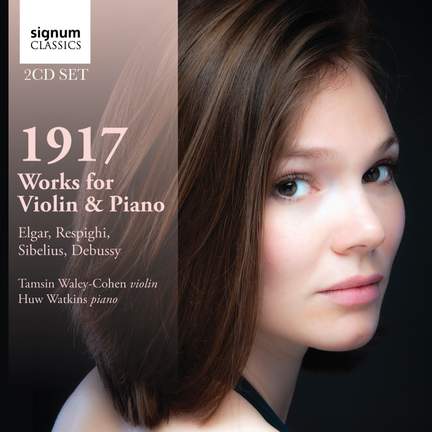
1917: Works for Violin and Piano
Tamsin Waley-Cohen (violin) & Huw Watkins (piano)
Waley-Cohen is much more than professional. The Elgar and Debussy in particular give plenty of evidence that she and her equally impressive partner, Huw Watkins, have thought hard about these...
1917: Works for Violin and Piano
Tamsin Waley-Cohen (violin) & Huw Watkins (piano)
Purchase product

Waley-Cohen is much more than professional. The Elgar and Debussy in particular give plenty of evidence that she and her equally impressive partner, Huw Watkins, have thought hard about these...
About
Rising-star violinist Tamsin Waley-Cohen is joined by the eminent pianist-composer Huw Watkins in a diverse programme of works that were all influenced in different ways by the era in which they were composed. The works were concieved at four very different points in the composer’s lives: Debussy, at the end of his life; Respighi in the first flush of fame; Elgar, although not old, enjoying his last creative period; and Sibelius in his prime, composing prolifically.
These four contrasting works were all composed as the Great War drew to a close, but none of them specifically attempts to conjure up images of the conflict, nor act as any kind of programmatic memorial to its victims. Rather, these works are all conceived as absolute music, albeit, in the case of the Elgar and Debussy sonatas, imbued with a melancholy regret that may have been a reflection of those tragic four years.
Contents and tracklist
Awards and reviews
 August 2014
Waley-Cohen is much more than professional. The Elgar and Debussy in particular give plenty of evidence that she and her equally impressive partner, Huw Watkins, have thought hard about these works...And the recordings serve both players - individually and as a duo - very well.
 12th June 2014
Respighi's expansive sonata [is] full of rhapsodic violin lines and grandly rhetorical piano writing. Waley-Cohen and Watkins clearly relish all that, but they seem more at home in the Debussy and Elgar works...The former is given a wonderfully subtle, introspective and touching performance; the latter is by turns typically bluff and elegiac.