Special offer. Bellini: Beatrice di Tenda
Paolo Gavanelli (Filippo Maria Visconti), Lucia Aliberti (Beatrice di Tenda), Camille Capasso (Agnese), Martin Thompson (Orombello), John David De Haan (Anichino), Raemond Martin (Rizzardo)
Chorus and Orchestra of the Deutschen & Oper Berlin, Fabio Luisi
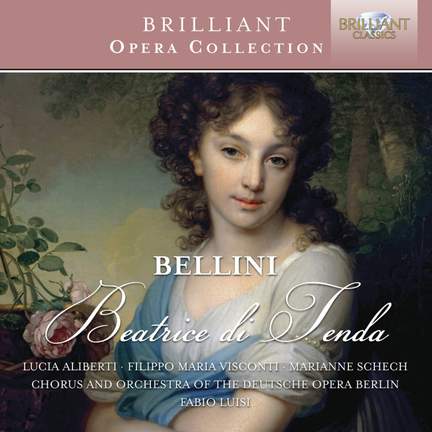
Luisi makes the best case for Bellini's least loved opera. If Aliberti's Beatrice is rarely graceful under vocal pressure, Gavanelli as Filippo is an almost Verdian villain.
Special offer. Bellini: Beatrice di Tenda
Paolo Gavanelli (Filippo Maria Visconti), Lucia Aliberti (Beatrice di Tenda), Camille Capasso (Agnese), Martin Thompson (Orombello), John David De Haan (Anichino), Raemond Martin (Rizzardo)
Chorus and Orchestra of the Deutschen & Oper Berlin, Fabio Luisi
Purchase product

Luisi makes the best case for Bellini's least loved opera. If Aliberti's Beatrice is rarely graceful under vocal pressure, Gavanelli as Filippo is an almost Verdian villain.
About
Packed with intrigue, jealousy and revenge, Beatrice di Tenda is a tragic opera in two acts that retells the final months of one of Renaissance history's most fascinating and ill-fated characters. The work was written after ‘Norma’ and before ‘I puritani’, and therefore stands as Bellini's penultimate opera, a bel canto composition of transitional flavour that drew on 15th-century accounts and more recent studies of the Visconti era for its subject matter. Beatrice di Tenda, widow of Facino Cane and a high-minded but powerconscious woman of mature years, is married to the young Filippo Maria Visconti, whose station has been considerably improved by Beatrice's dowry of property and armies. Instead of feeling grateful towards his wife, however, Filippo is tired of the much older Beatrice, and decides to take Agnese del Maino - one of her ladies-inwaiting - as his mistress. But Agnese is in love with a nobleman called Orombello, who himself is enamoured of Beatrice. Gradually becoming more suspecting of his wife's innocent relationship with the signore of Ventimiglia, and increasingly incensed by the rebellion of Facino's one-time followers who resent their new ruler, Filippo finally decides to rid himself of Beatrice by accusing her of adultery and conspiracy.
Subjected to torture along with Orombello, Beatrice was tried and eventually beheaded in 1418. First performed on 16 March 1833, ‘Beatrice di Tenda’, evidently more reserved in terms of musical resources when compared to the vocal pyrotechnics of its predecessor, was only half-heartedly received by the public, its number of performances gradually diminishing thereafter. In recent years, however, the work has undergone a resurgence in popularity, thanks largely to the American Opera Society's revival of the opera in 1961 (which featured Joan Sutherland and Marilyn Horne among others). This acclaimed recording is based on a production of the Deutsche Oper Berlin, which presented Beatrice di Tenda in a series of concert performances in 1992.
Contents and tracklist
- Paolo Gavanelli (soloist), Camille Capasso (soloist), Martin Thompson (soloist), Lucia Aliberti (soloist), Raemond Martin (soloist), John David Dehaan (soloist)
- Deutsche Oper Berlin, Chorus of the Deutsche Oper Berlin
- Fabio Luisi, Hellwart Matthiesen
- Paolo Gavanelli (soloist), John David Dehaan (soloist), Camille Capasso (soloist), Lucia Aliberti (soloist), Martin Thompson (soloist)
- Deutsche Oper Berlin, Chorus of the Deutsche Oper Berlin
- Fabio Luisi, Hellwart Matthiesen
Awards and reviews
 October 2013
Luisi makes the best case for Bellini's least loved opera. If Aliberti's Beatrice is rarely graceful under vocal pressure, Gavanelli as Filippo is an almost Verdian villain.