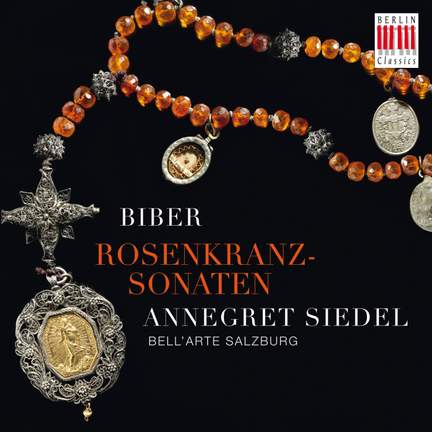
Biber: Rosenkrank Sonaten
Annegret Siedel (baroque violins)
Bell’arte Salzburg
it is her decision to focus on the music's 'process of intensification and withdrawal' that defines her readings. These are performances firmly in the meditative camp, seeking to move not by...
Biber: Rosenkrank Sonaten
Annegret Siedel (baroque violins)
Bell’arte Salzburg
Purchase product
it is her decision to focus on the music's 'process of intensification and withdrawal' that defines her readings. These are performances firmly in the meditative camp, seeking to move not by...
About
The fifteen Mystery (Rosary) Sonatas by Heinrich Ignaz Franz Biber form a fascinating cyclical work. The use of fourteen different violin tunings (scordaturas), deviating from the instrument’s normal tuning in fifths, makes the sonata cycle unique in the history of the violin. Each sonata is prefaced by a copperplate medallion depicting an event from the life of Mary and her son Jesus.
Biber took the pictures from a Rosary Brotherhood document (included with the generously documented CD) and they formed part of the neatly handwritten dedication to prince archbishop Maximilian Gandolph Count of Kuenburg (in office from 1668 to 1687). Biber was acknowledged as a gifted violinist and composer in his own lifetime. Born in northern Bohemia in 1644, he moved to Salzburg, where he was court kapellmeister, composing quantities of secular and sacred works. Kaiser Leopold I elevated Biber to the nobility in 1690. In his petition for noble rank, Biber referred to having given proof of his ability in Linz and Lambach with Violino soli for the emperor, with whom 'his playing had graciously found favour. Annegret Siedel, artistic director of the Bell’arte Salzburg ensemble, which specializes in early music from Salzburg, has recorded the Mystery Sonatas on nine different violins of the 17th and 18th centuries. She succeeds in wonderfully bringing out the sacred character of the music, particularly in its meditative passages, without falling short of the music’s high technical demands.
Contents and tracklist
- Salzburg Bell'Arte
- Annegret Siedel
- Recorded: 22-27 August 2011
- Salzburg Bell'Arte
- Annegret Siedel
- Recorded: 22-27 August 2011
- Salzburg Bell'Arte
- Annegret Siedel
- Recorded: 22-27 August 2011
- Salzburg Bell'Arte
- Annegret Siedel
- Recorded: 22-27 August 2011
- Salzburg Bell'Arte
- Annegret Siedel
- Recorded: 22-27 August 2011
- Salzburg Bell'Arte
- Annegret Siedel
- Recorded: 22-27 August 2011
- Salzburg Bell'Arte
- Annegret Siedel
- Recorded: 22-27 August 2011
- Salzburg Bell'Arte
- Annegret Siedel
- Recorded: 22-27 August 2011
- Salzburg Bell'Arte
- Annegret Siedel
- Recorded: 22-27 August 2011
- Salzburg Bell'Arte
- Annegret Siedel
- Recorded: 22-27 August 2011
- Salzburg Bell'Arte
- Annegret Siedel
- Recorded: 22-27 August 2011
- Salzburg Bell'Arte
- Annegret Siedel
- Recorded: 22-27 August 2011
- Salzburg Bell'Arte
- Annegret Siedel
- Recorded: 22-27 August 2011
- Salzburg Bell'Arte
- Annegret Siedel
- Recorded: 22-27 August 2011
- Salzburg Bell'Arte
- Annegret Siedel
- Recorded: 22-27 August 2011
- Salzburg Bell'Arte
- Annegret Siedel
Awards and reviews
 July 2013
it is her decision to focus on the music's 'process of intensification and withdrawal' that defines her readings. These are performances firmly in the meditative camp, seeking to move not by grabbing the lapels but through concentration and reflection