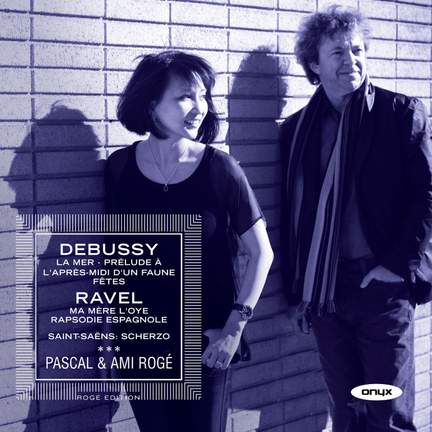
Special offer. Pascal & Ami Rogé play Debussy & Ravel
Pascal Rogé & Ami Rogé (pianos)
Awards:
-
Gramophone Magazine, September 2013, Editor's Choice

The Rogés' arrangement of Debussy's La mer is so resouceful that you hardly regret the absence of orchestral colour and range...you could hardly better the Rogés' presentation, finely recorded...
Special offer. Pascal & Ami Rogé play Debussy & Ravel
Pascal Rogé & Ami Rogé (pianos)
Purchase product

Awards:
-
Gramophone Magazine, September 2013, Editor's Choice
The Rogés' arrangement of Debussy's La mer is so resouceful that you hardly regret the absence of orchestral colour and range...you could hardly better the Rogés' presentation, finely recorded...
About
For his new ONYX CD Pascal is joined by his wife Ami for a programme of French masterworks for orchestra by Debussy and Ravel in arrangements for two pianos. The arrangement of 'La Mer' is the Rogés' own, the others are by the composers. The transcription by Maurice Ravel (1908) of Debussy’s 'Fetes', in the words of the distinguished musicologist Maurice Hinson, "has been translated into the two-piano idiom with independent artistry [and] ranks with the best original writing in the two-piano medium." Unlike Liszt’s single-movement 'Spanish Rhapsody' for solo piano, Ravel’s is a four-movement suite for two pianos: ‘Prélude à la Nuit’, ‘Malagueña’, ‘Habanera’ and ‘Feria’. It was written within the space of a few weeks in October but built around the ‘Habanera’ which had formed the first movement of his 'Sites articulaire' of 1895. Its recycling may have had something to do with Ravel’s resentment at being accused of plagiarising a passage from Debussy’s ‘La soirée dans Grenade’ of 1903 written in the same key with a habanera rhythm and a similar use of an insistent C sharp clashing against the harmonies.
Ravel pointedly attached the date ‘1895’ underneath his ‘Habanera’ in the two-piano score of Rapsodie espagnole and the orchestral version which he prepared in the early months of 1908.
Pascal Rogé has for many years been considered the prime interpreter of French piano repertoire. His recordings of Satie and the Debussy Preludes (ONYX4004) are benchmark recordings. BBC Radio 3 when reviewing the Debussy Preludes said they "came close to a definitive interpretation" and Telerama in France commented "Très beau, tres éduisant. Souverain".
Contents and tracklist
- Pascal Rogé, Ami Rogé
- Pascal Rogé, Ami Rogé
- Pascal Rogé, Ami Rogé
- Pascal Rogé, Ami Rogé
- Pascal Rogé, Ami Rogé
- Pascal Rogé, Ami Rogé
Awards and reviews
-
Gramophone MagazineSeptember 2013Editor's Choice
 September 2013
The Rogés' arrangement of Debussy's La mer is so resouceful that you hardly regret the absence of orchestral colour and range...you could hardly better the Rogés' presentation, finely recorded by Onyx.
 September 2013
Rewarding is the irresistible energy of ‘Fetes’ and Ravel’s equivalent counterpart in the closing ‘Feria’
 27th September 2013
Ravel in Spanish mode works very well for the two-piano combination. The rhythms of Malagueña and Habañera are crisply articulated. Feria is a suitably joyful affair, the opening of which loses nothing from the absence of orchestral timbres...It is interesting to have the Debussy arrangements but I would happily have this CD on account of the Ravel pieces, not forgetting the Saint-Saëns.
 9th June 2013
Here is quintessential Frenchness, beautifully realised, including a two-piano version of Debussy’s symphonic sketches, La Mer, by the players themselves, and wonderfully convincing it is, leaving little sense of orchestral deprivation.