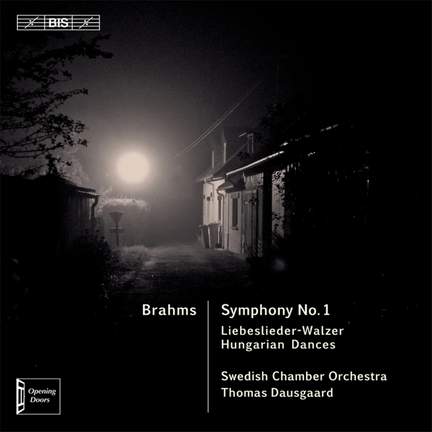
Brahms: Symphony No. 1
Swedish Chamber Orchestra, Thomas Dausgaard
Dausgaard secures superbly incisive playing from the Swedish Chamber Orchestra. Dausgaard favours swift tempos, especially in the outer movements...[His] penchant for disjunctive phrasing, and...
Brahms: Symphony No. 1
Swedish Chamber Orchestra, Thomas Dausgaard
Purchase product

Dausgaard secures superbly incisive playing from the Swedish Chamber Orchestra. Dausgaard favours swift tempos, especially in the outer movements...[His] penchant for disjunctive phrasing, and...
About
A weighty symphony, swaying Viennese waltzes and fiery Hungarian dances make up the colourful programme when Thomas Dausgaard and his Swedish Chamber Orchestra engage with Johannes Brahms in Opening Doors, the team’s acclaimed series of Romantic orchestral composers. Johannes Brahms was only twenty years old when Robert Schumann hailed him as one whose genius gave rise to the greatest symphonic hopes. It is therefore striking that he didn’t complete his First Symphony until more than twenty years later, in 1876 – even though the earliest sketches for it date back to 1855. Brahms – who once said that he constantly heard the ‘giant’ Beethoven ‘marching behind him’ – had such a deep respect for what his great predecessor had achieved with the genre that he for a long time doubted that he would ever be able to write a symphony of his own – by the time he did, it must have been gratifying to him that it was hailed as ‘Beethoven’s Tenth’. While working on the symphony, Brahms composed his Op.52, the cycle Liebeslieder-Walzer ‘for piano four-hands (and song ad libitum)’. He kept the forces as flexible as possible: the waltzes were performable with or without voices; if used, the vocal parts could be sung either by soloists or by a choir. Even so, he was soon asked for another version, for choir and orchestra. Brahms initially rejected this idea, but finally agreed to make a partial orchestration: selecting eight of the Op.52 waltzes, he supplemented them with an early version of one of the not yet published Neue Liebeslieder-Walzer, Op.65. Around the same time, he was asked to orchestrate another collection of dances composed for piano four-hands: his first set of Hungarian Dances, which had quickly become a great hit. It took him four years to comply with this wish, and even then he only accepted to orchestrate three of the dances, leaving the field open for various other arrangers (including Dvořák) to satisfy the demand for more.
Contents and tracklist
- Swedish Chamber Orchestra
- Thomas Dausgaard
- Recorded: March 2011
- Recording Venue: Orebro Concert Hall, Sweden
- Swedish Chamber Orchestra
- Thomas Dausgaard
- Recorded: March 2011
- Recording Venue: Orebro Concert Hall, Sweden
- Swedish Chamber Orchestra
- Thomas Dausgaard
- Recorded: March 2011
- Recording Venue: Orebro Concert Hall, Sweden
- Swedish Chamber Orchestra
- Thomas Dausgaard
- Recorded: March 2011
- Recording Venue: Orebro Concert Hall, Sweden
- Swedish Chamber Orchestra
- Thomas Dausgaard
- Recorded: March 2011
- Recording Venue: Orebro Concert Hall, Sweden
Awards and reviews
 June 2013
Dausgaard secures superbly incisive playing from the Swedish Chamber Orchestra. Dausgaard favours swift tempos, especially in the outer movements...[His] penchant for disjunctive phrasing, and his keen attention to inner detail, undoubtedly makes this performance a very stimulating experience.
 29th October 2013
This performance, with a smaller orchestra certainly starts with determination but is very different from established readings. I first thought the orchestra underpowered but had to revise this as the first movement continued...The benefit of the lesser forces brought forward the instruments with great clarity...Seasoned Brahms lovers should certainly get this disc