Special offer. Bartók: Violin Sonatas Nos. 1 & 2
James Ehnes (violin) & Andrew Armstrong (piano)
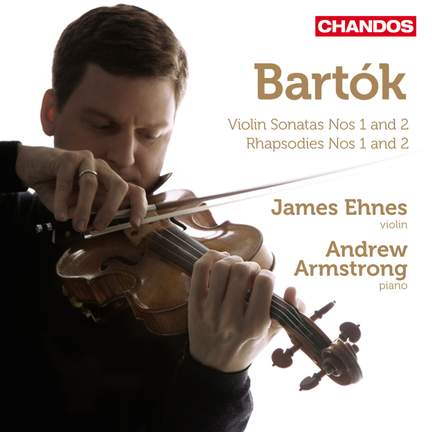
They are performances of outstanding musical insight and technical brilliance...James Ehnes and Andrew Armstrong perfectly encapsulate the anxieties projecting in both works...But they also...
Special offer. Bartók: Violin Sonatas Nos. 1 & 2
James Ehnes (violin) & Andrew Armstrong (piano)
Purchase product

They are performances of outstanding musical insight and technical brilliance...James Ehnes and Andrew Armstrong perfectly encapsulate the anxieties projecting in both works...But they also...
About
This is the second volume in a series devoted to the works for strings by Béla Bartók, with James Ehnes the featured soloist. Earlier this year, Ehnes recorded the Violin and Viola Concertos (CHAN10690), which was made Disc of the Month in Gramophone magazine. On this new recording, he turns to the Violin Sonatas and Rhapsodies, complemented by the earliest surviving work by Bartók for violin and piano, an Andante. He is accompanied by the pianist Andrew Armstrong.
Dedicated to the Hungarian violinist Adila d’Arányi, the sonatas for violin and piano were composed in 1921 – 22, around the same time as the highly successful ballet score The Miraculous Mandarin. Of the two works, the Sonata in C sharp minor is the more traditional in terms of its structure, and characterised by a mood that is sometimes exhilarated, sometimes turbulent – but always virtuosic. The finale builds from a series of increasingly wild dances, folk-like in style but entirely expressionistic.
In the Sonata in C major, Bartók removes himself from classical form and traditional tonal practice, calling on the violinist to distance himself from the romantic manner of playing. At several points, for example, the violin is played without vibrato, producing an ethereally cool and distant sound. The improvisatory character is strong throughout, as the work repeatedly alternates between the quiet and thoughtful, and the stormy and strident. The ending, in contrast to the earlier sonata, is understated, emotional, and expressive.
Bartók’s two rhapsodies for piano and violin, dedicated respectively to Joseph Szigeti and Zoltán Székely, are steeped in the tradition of Hungarian folk music. Exuberant and infectious, the works are heavily inspired by the csárdás, the national dance of Hungary, and display the traditional pairing of lassú (slow) and friss (lively) movements.
Contents and tracklist
- James Ehnes, Andrew Armstrong
- Recorded: 30 May–1 June 2011
- Recording Venue: Potton Hall, Dunwich, Suffolk
- James Ehnes, Andrew Armstrong
- Recorded: 30 May–1 June 2011
- Recording Venue: Potton Hall, Dunwich, Suffolk
- James Ehnes, Andrew Armstrong
- Recorded: 30 May–1 June 2011
- Recording Venue: Potton Hall, Dunwich, Suffolk
- James Ehnes, Andrew Armstrong
- Recorded: 30 May–1 June 2011
- Recording Venue: Potton Hall, Dunwich, Suffolk
- James Ehnes, Andrew Armstrong
- Recorded: 30 May–1 June 2011
- Recording Venue: Potton Hall, Dunwich, Suffolk
Awards and reviews
 March 2012
They are performances of outstanding musical insight and technical brilliance...James Ehnes and Andrew Armstrong perfectly encapsulate the anxieties projecting in both works...But they also find room for repose and reflection...As with Ehnes's recording of the Concertos, the present collection sweeps the board in terms of performance and generosity alike.
 March 2012
The performances are assertive but never excessively forceful, tonally sweet (useful in this often acerbic music) and, from Andrew Armstrong's standpoint, almost impressionist in their projection of nuance and tonal shading...an exceedingly generous programme (80'30''), expertly engineered, well planned, beautifully executed.
 February 2012
Ehnes has the measure of the fractured sonata design of the Allegro appassionato [in No. 1]...[He] gives a tellingly understated account of the preludial Molto moderato [in No. 2], dovetailing into a main Allegretto which open out its thematic and expressive potential so the work as a whole seems to unfold seamlessly towards a rapt and unifying postlude.
 June 2012
This is a magnificent disc, wonderful playing captured in fantastic sound, and a fine way to begin an exploration of Bartók’s work in this genre. Roll on Volume Two.