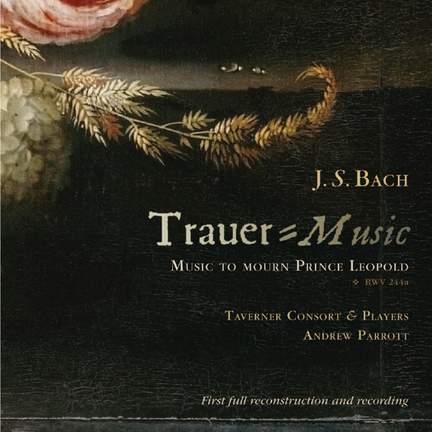
J S Bach: Trauer-Music
Music to Mourn Prince Leopold
Emily Van Evera (soprano), Clare Wilkinson (mezzo), Charles Daniels (tenor) & Tom Meglioranza (baritone)
Taverner Consort and Players, Andrew Parrott
High points include Susanne Heinrich's gamba solo during 'Komm susses Kreuz' in the Passion, and the way in which Wilkinson phrases 'Weh und Ach' (BWV244/6) with exceptional sensitivity and...
J S Bach: Trauer-Music
Music to Mourn Prince Leopold
Emily Van Evera (soprano), Clare Wilkinson (mezzo), Charles Daniels (tenor) & Tom Meglioranza (baritone)
Taverner Consort and Players, Andrew Parrott
Purchase product

High points include Susanne Heinrich's gamba solo during 'Komm susses Kreuz' in the Passion, and the way in which Wilkinson phrases 'Weh und Ach' (BWV244/6) with exceptional sensitivity and...
About
Period-instrument pioneer Andrew Parrott conducts his Taverner Consort and Players and a superb vocal roster of baroque specialists, in the first recording of his own reconstruction of J. S. Bach’s Trauer-Musik: Music to mourn Prince Leopold.
Andrew Parrott is a master of musicological detective work known for his adventurous and uncompromising scholarship. He is also internationally known for his pioneering historically informed performances and recordings of pre-classical repertory. This new release combines the best of both, resulting in the first full reconstruction and recording of the funeral music for J. S. Bach’s patron, Prince Leopold of Cöthen. Bach’s years in Cöthen were musically fertile and Prince Leopold was a knowledgeable and committed supporter of music and the arts, so it’s ironic that much of Bach’s output during those years has been lost or even destroyed. The score for Trauer-Musik, written in 1728 on the occasion of the Prince’s sudden death at the age of 34, has almost completely disappeared, yet through the discovery of numerous clues in other works and writings, Parrott has been able to recontruct what was clearly a heart-felt homage.
Parrott conducts the renowned Taverner Consort and Players, the organisation he founded in 1973, and a superb roster of baroque vocal soloists. A unique document and superb performance make this a recording for classical music aficionados and lovers of Bach’s music alike.
Contents and tracklist
Awards and reviews
 December 2011
High points include Susanne Heinrich's gamba solo during 'Komm susses Kreuz' in the Passion, and the way in which Wilkinson phrases 'Weh und Ach' (BWV244/6) with exceptional sensitivity and direction...Though this Trauer-Music is based on conjecture, and some of its music is newly-composed pastiche, it convincingly fills a yawning gap in Bach's mature output, and it's beautifully performed.
 December 2011
Given the familiarity, albeit somewhat displaced, of the music, it's the secular libretto that should garner the most interest. Diction, therefore, is the key to success, and these soloists thoroughly deliver...as none of the recitatives matched existing music, Parrott had to composer them all from scratch. The result is clearly the work of a Bach genius, the new vocal lines and rich instrumental scorings fitting seamlessly into the whole.
 December 2011
The adaptation takes some getting used to, especially when applying examples from the 'holy grail' of the St Matthew Passion...By and large, hearing the Passion in a different context is a deeply affecting, whatever one feels about speculative reworkings...The larger ensemble movements contain many revelatory moments in their easy, poignant lyricism...Parrott's critical uncovering of new meaning and intention is always thought-provoking
 January 2012
these are outstanding performances which transcend in the ears of any genuine lover of Bach's music the somewhat controversial nature of the music itself.
 June 2012
this reconstruction brings scholarship and highly informed speculation to bear and offers a convincing recreation of Bach’s final musical offering to his late master.
 18th December 2011
A fascinating piece of musical archaeology
The Independent on Sunday 9th October 2011
Using Picander's surviving libretto, Andrew Parrott has identified sympathetic material from the St Matthew Passion and the Trauer Ode to form four cantatas of mourning. The blend of familiar music and unfamiliar poetry is fascinating.
 18th February 2012
The use of one voice per part never sounds anaemic and the singers’ crystalline clarity is a joy to the ears...What’s most important is that the work sounds like a real, finished work, not a speculative completion. It’s beautifully recorded with good notes.