

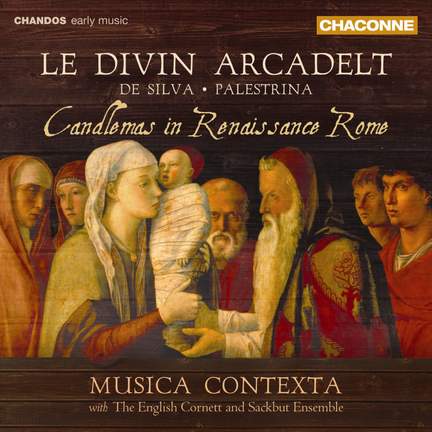
Le Divin Arcadelt: Candlemas in Renaissance Rome
Musica Contexta with The English Cornett and Sackbut Ensemble
I have no hesitation in acclaiming [Musica Contexta] as a vocal group of particular insight and sincerity which can bring a sense of realism to music of the sixteenth century...it feels as if...
Le Divin Arcadelt: Candlemas in Renaissance Rome
Musica Contexta with The English Cornett and Sackbut Ensemble
Purchase product

I have no hesitation in acclaiming [Musica Contexta] as a vocal group of particular insight and sincerity which can bring a sense of realism to music of the sixteenth century...it feels as if...
About
Through the works of Arcadelt, de Silva, and Palestrina, the vocal ensemble Musica Contexta, with The English Cornett and Sackbut Ensemble, takes us on a journey of musical Rome on a February day at the end of the sixteenth century. Imagine walking through the streets of the city at Candlemas, the Day of Purification - in the Catholic Church, this day celebrates the Purification of Mary and the official presentation of Christ at the Temple forty days after his birth - and at each church we come to we stop and listen to a piece of music. In one church we might find a single falsetto voice accompanied by sackbuts, in the next an unaccompanied choir, and elsewhere a full choir with wind instruments.
The reason for this diversity was that Rome, despite being the main exporter of religious customs, was musically very open to external influences. In a melting-pot of national styles, one of the strongest of these influences came from Iberian musicians such as Andreas de Silva. For a period of two years, de Silva held the position of ‘cantor et compositor’ of the Cappella Sistina in Rome, and it is here, in the Sistine Chapel, that his motet Ave Regina caelorum (recorded here) survives today.
The other great influence on Italian Renaissance music came from Northern France and the Low Countries. Between 1539 and 1551, Jacques Arcadelt was a member of the Cappella Sistina, where he would have come across de Silva’s motet, which he used as the basis for his Ave Regina caelorum mass (also recorded here). A case of plagiarism in today’s eyes, perhaps, but in the Renaissance, Arcadelt’s gesture would have been seen as paying de Silva the highest compliment. Truth be told, there are clear differences between the two: de Silva’s work is more tonally focused, and Arcadelt made several changes to the texture and word-setting. Also on this disc are two of Arcadelt’s motets, the sumptuous Pater noster and the emotionally charged Hodie beata virgo Maria.
In the year that Arcadelt left Rome to return to France, Palestrina arrived in the city. Part of a growing wave of native Italian musical talent, Palestrina enhanced the religious music scene in Rome with hundreds of compositions, including 105 masses, sixty-eight offertories, including Diffusa est gratia, at least 140 madrigals, and more than 300 motets, among them Senex puerum portabat.
Contents and tracklist
- English Cornett and Sackbut Ensemble, Musica Contexta, Simon Ravens
- English Cornett and Sackbut Ensemble, Musica Contexta, Simon Ravens
- English Cornett and Sackbut Ensemble, Musica Contexta, Simon Ravens
- English Cornett and Sackbut Ensemble, Musica Contexta, Simon Ravens
- English Cornett and Sackbut Ensemble, Musica Contexta, Simon Ravens
- English Cornett and Sackbut Ensemble, Musica Contexta, Simon Ravens
- English Cornett and Sackbut Ensemble, Musica Contexta, Simon Ravens
- English Cornett and Sackbut Ensemble, Musica Contexta, Simon Ravens
- English Cornett and Sackbut Ensemble, Musica Contexta, Simon Ravens
- English Cornett and Sackbut Ensemble, Musica Contexta, Simon Ravens
- English Cornett and Sackbut Ensemble, Musica Contexta, Simon Ravens
- English Cornett and Sackbut Ensemble, Musica Contexta, Simon Ravens
- English Cornett and Sackbut Ensemble, Musica Contexta, Simon Ravens
- English Cornett and Sackbut Ensemble, Musica Contexta, Simon Ravens
Awards and reviews
 July/August 2011
I have no hesitation in acclaiming [Musica Contexta] as a vocal group of particular insight and sincerity which can bring a sense of realism to music of the sixteenth century...it feels as if the music is still living and breathing, warts and all. Ravens, too, is an astute interpreter and guide through the sometimes difficult and labyrinthine passages of early polyphony...I recommend this disc wholeheartedly.
