Jacob Druckman: Brangle, Counterpoise & Viola Concerto
Dawn Upshaw (soprano), Roberto Díaz (viola)
Philadelphia Orchestra, Wolfgang Sawallisch, David Zinman
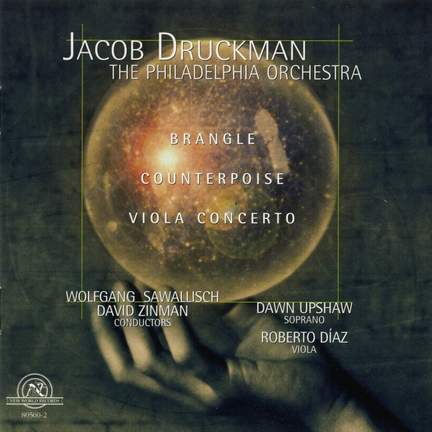
Jacob Druckman: Brangle, Counterpoise & Viola Concerto
Dawn Upshaw (soprano), Roberto Díaz (viola)
Philadelphia Orchestra, Wolfgang Sawallisch, David Zinman
Purchase product

About
This disc presents three of Jacob Druckman's (1928-1996) richest works spanning three decades, performed by the orchestra he grew up hearing as a youngster. Each makes a statement in an established genre-orchestral song, concerto, and dance suite-while moving beyond the formal or conceptual confines historically associated with those genres. Druckman's later style was marked by a deepening complexity which never flinched from dissonance, but always offered singable tunes and "beautiful" orchestral textures.
Most notable among these works was Counterpoise (1994), a piece which brings together several tendencies in Druckman's music, including a strong feel for poetry and vocalism and a penchant for the duality expressed by the Apollonian and Dionysian cults of ancient Greece. "The musical development of Counterpoise is strongly focused on, and colored by, the great contrast between the two poets: Emily Dickinson and Guillaume Apollinaire," the composer wrote in his original program note. "The American poet's giddy spiritual ecstasy and the French poet's visions of sadness and dementia seem to pull in opposite directions at the ends of a single straight line."
The Viola Concerto (1978) is a work built on structural rigor-it includes some twelve-tone techniques-but which uses the orchestra as a vastly colorful palette. "The theme of my Viola Concerto is the transformation of the relationship between the soloist and the orchestra," the composer wrote. "The beautiful but slightly veiled voice of the viola is surrounded by the terrible power of the full orchestra. There is an insistent pattern: the viola initiates the activity, the orchestra at first following. The soloist gradually unleashes the force of the orchestra as the orchestra seizes upon moments in his discourse and imitates, underlines, elaborates, and transforms them.
Sandwiched chronologically between these two works is Brangle (1989). In the composer's words, the piece is "concerned with dance: the rhythms and physicality of kinetic energy." Its bracing textures are dedicated to idea that music of the post–World War II avant garde had often turned its back on this most essential of human elements in music-namely, pulse. The title refers to "brangling," a sort of shaking or vibrating, but the term also alludes to similarly titled Renaissance dances, as a reflection of the composer's deep knowledge of the music of earlier styles and periods.