Elliott Carter: Piano Concerto & Variations for Orchestra
Ursula Oppens (piano)
Cincinnati Symphony Orchestra, Michael Gielen
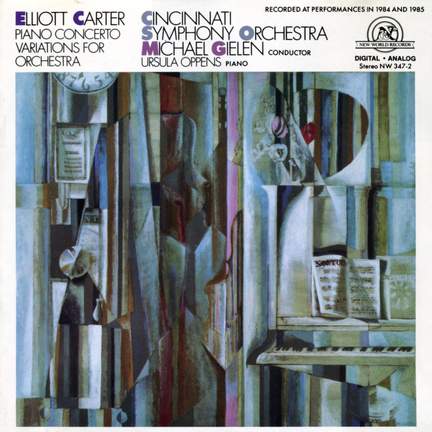
Elliott Carter: Piano Concerto & Variations for Orchestra
Ursula Oppens (piano)
Cincinnati Symphony Orchestra, Michael Gielen
Purchase product

About
The Variations for Orchestra and the Piano Concerto belong to two different decades and stylistic periods. The Variations, commissioned by the Louisville Orchestra and written in Rome in 1954-55, are a summation of the works Carter wrote after the stylistic breakthrough of the Cello Sonata of 1948. Aaron Copland once remarked on Carter's wide knowledge of the music of his time; the Variations are a monumental synthesis of many different kinds of modern music (and in an overt way that Carter never again attempted). There are not only surface resemblances to Schoenberg and Berg, but there is also Carter's closest approach to serial technique. Charles Ives, who died while Carter was composing the work, is invoked explicitly in Variation 7, and Ives's technique of superimposition is the basis of the whole work's texture and form. Also present in the music are the spirit of Debussy, particularly of La Mer and Jeux; the rhythmic experiments of Conlon Nancarrow and Henry Cowell; jazz (variation 8); and even the rhetoric of the Great American Symphony of Harris, Copland, and Schuman. In addition to these many stylistic strands, Carter also attempted to use all possible variation techniques, including an array of canonic and contrapuntal devices— Variation 2, for instance, is a free mensuration canon in which the size of intervals varies along with the rhythmic values.
The Piano Concerto, written in Berlin in 1964-65, explores the tragic possibilities of an alienated texture on a visionary scale. Carter has pointed out on several occasions the influence of the Berlin setting, and the newly built Wall, on the work. Carter sets the piano against the orchestra (asking, if it is possible, that they be clearly separated spatially), and their conflict intensifies throughout the work. It's not a question of soloist and orchestra simply elaborating different materials#151;we can find that in Vivaldi; rather, here the piano and orchestra represent irreconcilable and violently opposed principles.
Contents and tracklist
- Ursula Oppens
- Cincinnati Symphony Orchestra
- Michael Gielen
- Ursula Oppens
- Cincinnati Symphony Orchestra
- Michael Gielen