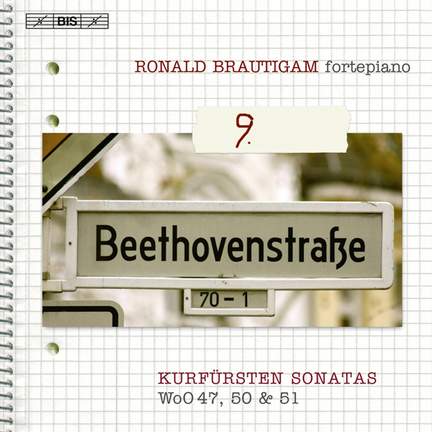
Beethoven - Complete Works for Solo Piano Volume 9
Ronald Brautigam (fortepiano)
Brautigam's propensity for fast speeds occasionally robs the music of its naive charm, but at least he never fails to bring it to life
Beethoven - Complete Works for Solo Piano Volume 9
Ronald Brautigam (fortepiano)
Purchase product

Brautigam's propensity for fast speeds occasionally robs the music of its naive charm, but at least he never fails to bring it to life
About
In eight previous volumes Ronald Brautigam has traversed what is often called 'The New Testament of Piano Music', namely Beethoven's 32 numbered sonatas. The present disc may be regarded as an appendix to these, as it explores the composer's first attempts in the genre. It opens with the three Kurfürsten Sonatas from 1783, in which Beethoven - at the tender age of twelve - demonstrates a remarkable maturity. With influences from C.P.E. Bach's ground-breaking keyboard music, as well as the sonatas from Haydn's 'Sturm und Drang' perod, the pieces earn their nickname from being dedicated to Archduke Maximilian Friedrich, Kurfürst of Cologne and the employer of Beethoven's father. The Kurfürsten Sonatas were published upon completion, whereas the remaining, later pieces on this disc remained unpublished during Beethoven's lifetime. Zwei Sätze einer Sonatine and Zwei Stücke für Klavier (Orphika) - often called 'Leichte Sonate' - were composed as gifts to two friends from Beethoven's youth: Franz Wegeler and Eleonore von Breuning. In the case of the Two Easy Sonatinas, the manuscript scores were found among Beethoven's papers after his death. There is no proof that Beethoven really is the composer, however, and although they are usually dated as having been written around 1790, this is no more than an educated guess. As a whole, the pieces presented here are the earliest so far in this series, and Ronald Brautigam has consequently chosen to introduce a new instrument for his performances: a copy of a fortepiano by Johann Andreas Stein from 1788. The opportunity it provides of following the evolution of the piano during a momentous period in piano music and instrument building certainly adds to the attractions of this universally acclaimed series. But Brautigam's interpretations have a directness and urgency to them that far surpasses such considerations - as summed in a review in Classic FM Magazine of a recent instalment: 'Brautigam has more to say about the music than any recent cycle recorded on modern instruments. An outstanding disc of an outstanding series.'
Contents and tracklist
- Ronald Brautigam
- Recorded: August 2008
- Recording Venue: Osteraker Church, Sweden
- Ronald Brautigam
- Recorded: August 2008
- Recording Venue: Osteraker Church, Sweden
- Ronald Brautigam
- Recorded: August 2008
- Recording Venue: Osteraker Church, Sweden
- Ronald Brautigam
- Recorded: August 2008
- Recording Venue: Osteraker Church, Sweden
- Ronald Brautigam
- Recorded: August 2008
- Recording Venue: Osteraker Church, Sweden
- Ronald Brautigam
- Recorded: August 2008
- Recording Venue: Osteraker Church, Sweden
- Ronald Brautigam
- Recorded: August 2008
- Recording Venue: Osteraker Church, Sweden
- Ronald Brautigam
- Recorded: August 2008
- Recording Venue: Osteraker Church, Sweden
Awards and reviews
 December 2010
Brautigam's propensity for fast speeds occasionally robs the music of its naive charm, but at least he never fails to bring it to life
 November 2010
Brautigam brings these works to life by lavishing on them the same care and engaged musicality that have distinguished his cycle's finest performances to date...This may be minor Beethoven, yet Brautigam's interpretations are never less than major, and sumptuously engineered too.