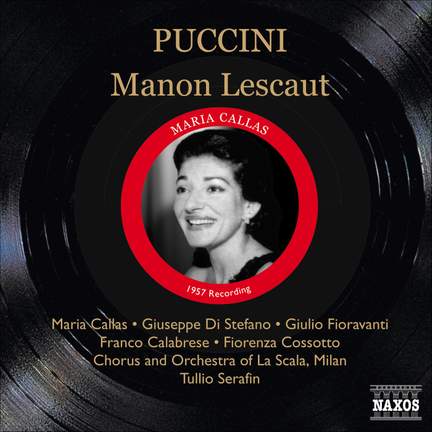
Puccini: Manon Lescaut
Maria Callas, Giuseppe di Stefano, Giulio Fioravanti, Franco Calabrese, Dino Formichini & Dino Formichini
Chorus and Orchestra of La Scala, Milan, Tullio Serafin
Callas thinks herself well into what becomes, to begin with, a more serious, calculating Manon - and a very accurate Manon, too. Then, dying in the wilderness in Act 4, she produces a performance...
Puccini: Manon Lescaut
Maria Callas, Giuseppe di Stefano, Giulio Fioravanti, Franco Calabrese, Dino Formichini & Dino Formichini
Chorus and Orchestra of La Scala, Milan, Tullio Serafin
Purchase product

Callas thinks herself well into what becomes, to begin with, a more serious, calculating Manon - and a very accurate Manon, too. Then, dying in the wilderness in Act 4, she produces a performance...
About
Transferred by the award-winning Mark Obert-Thorn, this 1957 recording of Manon Lescaut with Callas singing the title rôle and Di Stefano as des Grieux, was one of Callas’s last complete recordings at La Scala, Milan.
Although the strain of her recent recording of Turandot (Naxos 8111334-35) sometimes takes its toll, her command of Manon is complete.
Those pages that are rarely sung accurately by other lyric sopranos, for example ‘L’ora, o Tirsi’ from Act II, Callas sings with polish and precision, executing the triplets with perfect rhythmic command.
Contents and tracklist
- Recorded: 18-20, 22, 24-27 July 1957
- Recording Venue: Teatro alla Scala, Milan, Italy
- Recorded: 06 December 1947
- Recording Venue: EMI Abbey Road Studio No. 1, London, UK
- Recorded: 20 June 1955
- Recording Venue: Teatro alla Scala, Milan, Italy
- Recorded: 22 June 1955
- Recording Venue: Teatro alla Scala, Milan, Italy
Awards and reviews
 July 2010
Callas thinks herself well into what becomes, to begin with, a more serious, calculating Manon - and a very accurate Manon, too. Then, dying in the wilderness in Act 4, she produces a performance so harrowing that it should surely claim a prime spot on any fantasy best-of-Callas single disc.
 2010 edition
It is typical of Callas that she turns the final scene into the most compelling part of the opera. Serafin, who could be a lethargic recording conductor, is here electrifying, and Di Stefano too is inspired to one of his finest complete opera recordings.