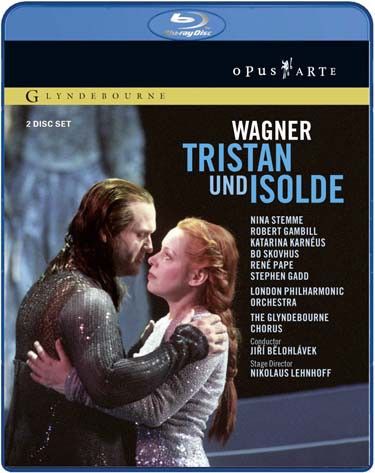
Wagner: Tristan und Isolde
Robert Gambill (Tristan), Nina Stemme (Isolde), Katarina Karnéus (Brangäne), Bo Skovhus (Kurwenal), René Pape (König Marke), Stephen Gadd (Melot), Timothy Robinson (Hirt/Junger Seemann)
The Glyndebourne Chorus & London Philharmonic Orchestra, Jirí Belohlávek, Nikolaus Lehnhoff
Awards:
-
Building a Library, June 2011, First Choice (Blu-ray)

-
Presto Favourites, Recommended Recording

Stemme's fiery Irish princess is even finer than on the Domingo CD… Gambill's burly Tristan projects a darker, more resigned intensity… Pape's black-voiced Marke rightly dominates the stage…...
Wagner: Tristan und Isolde
Robert Gambill (Tristan), Nina Stemme (Isolde), Katarina Karnéus (Brangäne), Bo Skovhus (Kurwenal), René Pape (König Marke), Stephen Gadd (Melot), Timothy Robinson (Hirt/Junger Seemann)
The Glyndebourne Chorus & London Philharmonic Orchestra, Jirí Belohlávek, Nikolaus Lehnhoff
Purchase product
Awards:
-
Building a Library, June 2011, First Choice (Blu-ray)
-
Presto Favourites, Recommended Recording
Stemme's fiery Irish princess is even finer than on the Domingo CD… Gambill's burly Tristan projects a darker, more resigned intensity… Pape's black-voiced Marke rightly dominates the stage…...
About
Note: This Blu-ray Disc (BD) is not compatible with standard DVD players
Glyndebourne’s celebrated production of Nikolaus Lehnhoff’s Tristan und Isolde is a supremely intelligent achievement; gravely beautiful, haunting and meditative, it is deeply reflective rather than visceral, fortified by Roland Aeschlimann's stunningly effective set, a womb-like space through which the protagonists move like gods. Conductor Jirí Belohlávek mirrors Lehnhoff's approach in his sophisticated plumbing of the score's depths, with every shift in texture carefully laid bare by an inspired London Philharmonic Orchestra. Nina Stemme's Isolde and Robert Gambill's Tristan, both gloriously lyrical, are matched by superb performances from René Pape as the betrayed and vulnerable King Marke and Bo Skovhus as Kurwenal, deeply touching in his helpless devotion to Tristan. This High Definition recording of a production of uncommon intimacy reveals the opera's music and drama in a new light.
Picture: 1080i High Definition / 16:9
Sound: 2.0 & 5.0 Dolby TrueHD
Video codec: AVC/MPEG-4
Disc size: 2 x BD50
Subtitles: EN/FR/DE/ES/IT Menu language: EN
Region code: All regions
Running time: Approx 358 mins
Bonus material:
Illustrated synopsis & cast gallery
Do I hear the light? - a film by Reiner E. Moritz
Artist biographies.
‘On the set’ - a slide show of the set being built.
‘Trimborn on Tristan’ – a talk by Richard Trimborn
‘I don’t think that I have ever witnessed a more perfect realisation of a Wagner opera than this superb Tristan und Isolde. …[Jirí Belohlávek] is scrupulous with the score, and takes his time over it: the pauses and silences are immense and there is no factitious attempt to whip up excitement by speeding. …a great and unforgettable occasion’ The Daily Telegraph
Contents and tracklist
- Recorded live at Glyndebourne, Lewes, Sussex on 1st August and 6th August 2007.
- Robert Gambill (Tristan), Nina Stemme (Isolde), Katarina Karnéus (Brangäne), Bo Skovhus (Kurwenal), René Pape (König Marke), Stephen Gadd (Melot), Timothy Robinson (Hirt/Junger Seemann), Richard Mosley-Evans (Steuermann)
- The Glyndebourne Chorus & London Philharmonic Orchestra
- Jiří Bělohlávek (conductor) & Nikolaus Lehnhoff (stage director)
Spotlight on this release
-
An error occurred.
Try watching this video on www.youtube.com, or enable JavaScript if it is disabled in your browser.
Awards and reviews
-
Presto FavouritesRecommended Recording
 March 2008
Stemme's fiery Irish princess is even finer than on the Domingo CD… Gambill's burly Tristan projects a darker, more resigned intensity… Pape's black-voiced Marke rightly dominates the stage… Karneus is a passionate, lusciously sung Brangäne. Lehnhoff's Glyndebourne production doesn't outclass Daniel Barenboim's magnificent video... But those looking for a Tristan with warmth and immediacy will find it certainly shares Barenboim's benchmark recommendation.
 2010
2010
a performance realised to Glyndebourne's highest standards – the chorus and stage brass are Bayreuthlevel, the casting immaculate (they can all really sing these parts), and Belohlávek's conducting balanced with a Goodall-like attention to the filigree detail of Wagner's new-wave scoring.
Old-style analyses of the music used to talk about the 'glance' motif. Lehnhoff's staging deploys a series of heartbreaking glances: Stemme's Isolde when Karnéus's Brangäne tells her she's taken the love draught, Stemme again when Tristan arrives in Act 2, Pape's Marke as he sees the lovers together and, at BrokebackMountain-level, Skovhus's Kurwenal as he cradles Gambill's Tristan then breaks away, half in fear of his lord's death, half in fear of his feelings for him. In fact, has a Tristan ever been so deeply loved by his lady and squire as here, or felt so wretched at betraying his king? And is Skovhus actually the greatest Kurwenal yet recorded? Roland Aeschlimann provides a geometrically attractive whorl of a standing set, concentric wooden circles telescoping towards a constantly varied horizon: a ship, a spaceship, everywhere, nowhere – perfect. The lighting (Robin Carter and Aeschlimann) has a genuine physical presence and seems to reinvent the colour blue. At the point of Isolde's almost belated arrival in Act 3, a surreal, Ingmar Bergman-like atmosphere permeates events: she arrives from behind on high as a figure of death and wraps him in a black cloak, while Skovhus's poignant Kurwenal gets a non-realistic, Brechtian centre-stage for his fights and death
 August 2008
A performance realised to Glyndebourne's highest standards - the chorus and stage brass are Bayreuth-level, the casting immaculate (they can all really sing these parts) and Belohlávek's conducting balanced with a Goodall-like attention to the filigree detail of Wagner's new-wave scoring

I don’t think that I have ever witnessed a more perfect realisation of a Wagner opera than this superb Tristan und Isolde. …[Jirí Belohlávek] is scrupulous with the score, and takes his time over it: the pauses and silences are immense and there is no factitious attempt to whip up excitement by speeding. …a great and unforgettable occasion