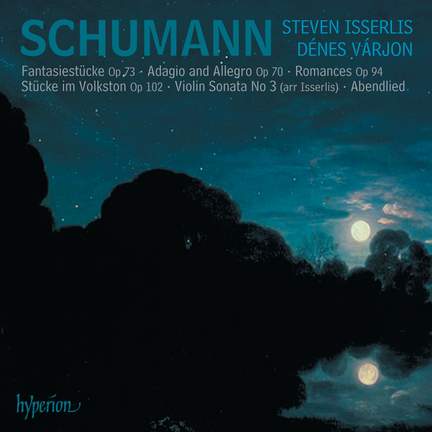
Schumann - Music for cello and piano
Steven Isserlis (cello) & Dénes Várjon (piano)
Awards:
-
Gramophone Magazine, May 2009, Editor's Choice

The really exciting performance here is Steven Isserlis's transcription of Schumann's valedictory Third Sonata: it's as if he's been preparing all his life to launch into its dark storm. This...
Schumann - Music for cello and piano
Steven Isserlis (cello) & Dénes Várjon (piano)
Purchase product

Awards:
-
Gramophone Magazine, May 2009, Editor's Choice
The really exciting performance here is Steven Isserlis's transcription of Schumann's valedictory Third Sonata: it's as if he's been preparing all his life to launch into its dark storm. This...
About
‘There is no composer to whom I feel closer than to Schumann. He has been a beloved friend since I was a child; I remain as fascinated today as I was then by his unique blend of poetry, ecstatic strength and confessional intimacy.’ Steven Isserlis’s own words give the background to this fascinating disc.
Schumann’s affection for the cello ran deep. It was an instrument he had played in his youth, and considered taking up again when, at the age of twenty-two, an accident to his hand forced him to relinquish his dream of being a virtuoso pianist. ‘I want to take up the violoncello again (one needs only the left hand for this) and it will be very useful to me in composing symphonies’, he wrote to his mother. The sound of the cello played without the right hand would have been somewhat minimalist; but his love for the instrument is clearly demonstrated by the cello parts in all four of his symphonies, as well as in the concertos for piano and violin, and of course throughout his chamber music. As the great musicologist Donald Francis Tovey put it: ‘The qualities of the violoncello are exactly those of the beloved dreamer whom we know as Schumann.’
Contents and tracklist
Spotlight on this release
-
An error occurred.
Try watching this video on www.youtube.com, or enable JavaScript if it is disabled in your browser.
Awards and reviews
-
Gramophone MagazineMay 2009Editor's Choice
 April 2009
The really exciting performance here is Steven Isserlis's transcription of Schumann's valedictory Third Sonata: it's as if he's been preparing all his life to launch into its dark storm. This fabulously virtuosic and psychologically complex work forces his musicianship up to a new level. It's full of fiendish passages, lying extremely awkwardly on the instrument, but, even in the Finale, Isserlis masters these explosive flourishes and has the vital impetus to make an eccentric work feel whole.
 2010
2010
Steven Isserlis has long been a stalwart champion of Schumann, through his advocacy of not only the often-maligned Concerto but also the chamber works. For this disc he has had to beg, borrow and steal but the results absolutely justify the means.
In the wrong hands, a work such as the Fantasiestücke, Op 73 (which Isserlis plays in its earliest incarnation), can sound a touch seasick, with too much swelling through every phrase, and a loss of the overall shape as a result. But how well Isserlis paces everything; some of his tempi are quite spacious but this gives the music a wonderfully considered and luxuriant aspect; the results never ever sound contrived. That's partly to do with Isserlis's sound (extravagantly he uses not one but two Strads on this recording), which has a very focused centre to it, but also his utterly innate relationship with pianist Dénes Várjon.
Perhaps the most ravishing item on the disc is the poignant Abendlied, arranged by Joachim from its piano duet form but then further borrowed by Isserlis, playing it down an octave. In his hands it's as moving a wordless Lied as anything you could imagine.
The substantial work here, though, is the Third Violin Sonata. Two of its movements – the Intermezzo and finale – originated in the multi-composer 'FAE' Sonata written for Joachim (for which Brahms famously wrote the Scherzo). Schumann later added two more movements to form his last large-scale work. It decisively refutes the theory that he had – metaphorically and literally – lost the plot by this stage. While it certainly doesn't conform to standard 19th-century sonata form, in Isserlis's hands it's a work of compelling power, whether in the terrifying scherzo sections of the second movement or the dreamy Intermezzo, a muchneeded point of repose in a work of great tumult.
The disc ends with the Fünf Stücke im Volkston, and finds Schumann in a more folky idiom. Too often these pieces can sound like an awkward amalgam of styles, but Isserlis again is utterly inside them, revealing Schumann's innovation even at this late stage, from the edginess of the first, via the tender, Brahmsian second one to the spirited fifth piece, where Mendelssohn collides with Bartók.
For all that Isserlis has made many wonderful recordings, not least his seminal Bach Suites, this might just be his finest yet, with warmly detailed sound and a typically acute note from the cellist himself.
 May 2009
Perhaps the most ravishing item on the disc is the poignant Abendlied, arranged by Joachim from its piano duet form but then further borrowed by Isserlis, playing it down an octave. In his hands it's as moving a wordless Lied as anything you could imagine. For all that Isserlis has made many wonderful recordings, not least his seminal Bach Suites, I think this might just be his finest yet, with warmly detailed sound... and a typically acute note from the cellist himself.
 July/August 2011
For any collector wishing to explore Schumann's music for cello and piano, Isserlis and Varjon are the obvious partnership of choice, and it is hard to imagine such superlative performances being easily matched, even less displaced.
 15th March 2009
If the Five Pieces in Folk Mode, Op 102, actually written for the cello, stand out from the rest, the whole programme is a delight, as both artists catch the music’s poetic ebb and flow to perfection
 21st February 2009
This music sings and soars, flying to the instrument's highest reaches with dreamy eloquence and a sense of rightness, even though some of the works were intended for other instruments...with pianist Dénes Várjon as equal partner, [Isserlis] plays with fierceness and soul.
 28th February 2009
Isserlis’s passion for Schumann overcomes the composer’s threadbare cello repertoire with this selection of works. But Abendlied still charms, an octave down, and the Stücke im Volkston is a blast of untranscribed Technicolor, picked out with vigour, charisma and delicacy.