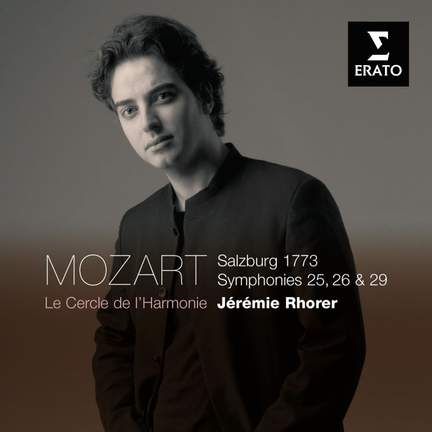
Mozart - Symphonies Nos. 25, 26 & 29
Le Cercle de l’Harmonie, Jérémie Rhorer
These are, in the main, finely-judged performances, and there are certain moments, such as the snarling crescendo on all four horns that catapults the recapitulation in the opening movement...
Mozart - Symphonies Nos. 25, 26 & 29
Le Cercle de l’Harmonie, Jérémie Rhorer
Purchase product

These are, in the main, finely-judged performances, and there are certain moments, such as the snarling crescendo on all four horns that catapults the recapitulation in the opening movement...
About
Inspired by his recent stay in Italy, and back at the court of the Archbishop of Salzburg, the 17-year-old Mozart composed five symphonies in 1773-74; Nos 25, 26 and 29 were among them. These inventive, finely proportioned works achieve a fusion between the light, three-movement sinfonia, or Italian overture, and the German symphony – denser, usually in four movements, and including a minuet.
French conductor Jérémie Rohrer, born in Paris in 1973, worked with Marc Minkowski, William Christie and Christopher Hogwood before founding Le Cercle de l’Harmonie in April 2005 with the violinist Julien Chavin and a number of close colleagues. The group focuses on orchestral and operatic repertoire of the late 18th century and has collaborated with dazzling German soprano Diana Damrau on two Virgin Classics releases: Arie de bravura by Mozart, Salieri and Righini, which (following the highest praise in Gramophone, Opera News, Diapason, Télérama, Opéra International, Classica Repertoire, and a Preis der deutschen Schallplattenkritik) has sold 25,000 copies around the world, and the recently released all-Mozart album Donna.
The first of these two releases prompted the German magazine Das Opernglas to praise conductor and orchestra with these words: “The orchestra makes the most of all the moods in these scores, bringing power and succulence, but also an exceptional sense for nuance,” while the French newspaper Libération said: “It is ages since we heard Mozart’s harmony exalted to such mouthwatering effect.”
“Gathered around Jérémie Rhorer, Le Cercle de l’Harmonie offers a sumptuous Mozartian feast. Impeccably executed, with incisive energy in the chords, polyphonic clarity, beauty of tone: everything is delectable … Long live this circle of harmony!” Diapason
“For Jérémie Rhorer and his partners, it is a case of fidelity rewarded. Fidelity to their idea of musical purity, of artistic distinction – a Mozartian ideal, in fact.” Télérama
“Le Cercle de l’Harmonie, with each musician playing as if his or her life depended on it.” Altamusica
Contents and tracklist
- Le Cercle de l’Harmonie
- Jérémie Rhorer
- Recorded: 2008-05-25
- Recording Venue: 25-29 May, 2008. Ferme de Villefavard en Limousin, France
- Le Cercle de l’Harmonie
- Jérémie Rhorer
- Recorded: 2008-05-25
- Recording Venue: 25-29 May, 2008. Ferme de Villefavard en Limousin, France
- Le Cercle de l’Harmonie
- Jérémie Rhorer
- Recorded: 2008-05-25
- Recording Venue: 25-29 May, 2008. Ferme de Villefavard en Limousin, France
Awards and reviews
 September 2009
These are, in the main, finely-judged performances, and there are certain moments, such as the snarling crescendo on all four horns that catapults the recapitulation in the opening movement of the turbulent Symphony No. 25, that sound particularly effective.
 April 2009
…there is a lot of controlled energy in these performances, immediately apparent in the first movement of Symphony No 25, which is driven but not forced, effectively opposing vigorously scrubbed violins and urgently pressed horn-blasts with a touchingly plaintive solo oboe in its second theme. ...plenty of neat and imaginative articulation and phrasing reach their collective zenith in the richly unfolding delights of the slow movement of No 29.
 15th March 2009
However well you know these symphonies, the zest, detail and exuberance of these performances will blow your head off. Mozart was 17, fired up by months in Italy, when he went to work at the archbishop's court in Salzburg. These symphonies, here recorded in a converted Limousin barn, date from that period. Young French conductor Jérémie Rhorer, and the agile period instrument band Le Cercle de l'Harmonie take risks but not liberties. Speeds are break-neck, colours brilliant.