

Help
Skip to main content

US TARIFFS UPDATE | August 2025 | No impact expected on your Presto orders | Read full details

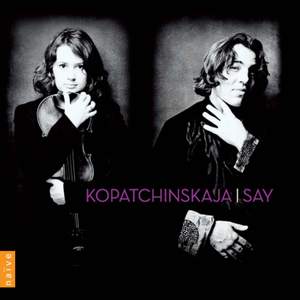
Kopatchinskaja & Fazil Say - Violin Sonatas

Patricia Kopatchinskaja (violin) & Fazil Say (piano)

Kopatchinskaja & Fazil Say - Violin Sonatas

Awards:

This is far from being just another recording of the Kreutzer Sonata. Patricia Kopatchinskaja and Fazil Say share a radical approach, performing each musical gesture in the most vivid way, with...

Kopatchinskaja & Fazil Say - Violin Sonatas

Patricia Kopatchinskaja (violin) & Fazil Say (piano)

Purchase product

44.1 kHz, 16 bit, FLAC/ALAC/WAV

$13.00

320 kbps, MP3

$10.00

No digital booklet included

Stream now lossless, 44.1 kHz, 16 bit

Awards:

This is far from being just another recording of the Kreutzer Sonata. Patricia Kopatchinskaja and Fazil Say share a radical approach, performing each musical gesture in the most vivid way, with...

About

One of the most promising violinists of the new generation, young Moldovan Patricia Kopatchinskaja makes her Naïve debut with a captivating disc that includes Beethoven’s masterpiece, the “Kreutzer” Sonata, Ravel’s Violin Sonata, Bartók’s Romanian Dances and the premier recording of the Violin Sonata by her accompanist, the outstanding Turkish pianist and composer, Fazil Say. Beethoven’s Violin Sonata No. 9 in A, commonly known as the “Kreutzer” Sonata, was published in 1802, and is known for its demanding violin part, unusual length and emotional scope. The piece’s title comes from its dedicatee, Rodolphe Kreutzer, who was considered to be the finest violinist of the day. Ironically, Kreutzer never performed it, and considered it unplayable.

Patricia Kopatchinskaja was born in Moldavia (now Moldova), and studied composition and the violin in Vienna and Berne before winning first prize in the International Henryk Szeryng Competition in 2000, followed two years later by the prestigious Crédit Suisse Group Young Artist Award. She represented Austria in the ‘Rising Stars’ concert series in the main European centres and New York. In 2004 she received the New Talent-SPP Award from the EBU and in 2006 the Förderpreis Deutschlandfunk, and now plays with leading orchestras and major festivals worldwide. More information at www.patkop.ch

Born in Ankara in Turkey, Fazil Say studied piano and composition at the State Conservatory of his home city. At 17 he was awarded a scholarship enabling him to work for five years with David Levine at the Robert Schumann Institute in Düsseldorf. From 1992-1995 he pursued his studies at the Berlin Conservatory. Say’s discography includes Stravinsky’s four-hand arrangement of The Rite of Spring, in which he plays both parts himself. This recording brought him several international awards, including the 2001 EchoPreis Klassik and the German Music Critics’ Best Recording of the Year. For Naïve, he has made recordings of Mozart Piano Concertos Nos. 21, 21 & 23 (V4992) and Beethoven’s ‘Appassionata’, ‘Tempest’ & ‘Waldstein’ Sonatas (V5016), and his own music, Black Earth (V4954). His most recent CD, a selection of Haydn Sonatas (V5070), was released in 2007. He gives a recital at the Edinburgh International Festival on 19 August.

Contents and tracklist

I. Adagio sostenuto - Presto
Track length10:15
II. Andante con variazioni
Track length13:17
III. Finale: Presto
Track length6:32
I. Allegretto
Track length8:20
II. Blues
Track length6:17
III. Perpetuum mobile: Allegretto
Track length3:43
No. 1. Jocul cu bata (Stick Dance)
Track length1:16
No. 2. Braul (Sash Dance)
Track length0:31
No. 3. Pe loc (In One Place)
Track length1:21
No. 4. Buciumeana (Horn Dance)
Track length1:15
No. 5. Poarga Romaneasca (Romanian Polka)
Track length0:29
No. 6. Maruntel (Fast Dance)
Track length0:57
I. Introduction: Melancholy
Track length3:01
II. Grotesque
Track length2:07
III. Perpetuum mobile
Track length1:44
IV.
Track length3:09
V. Epilogue: Melancholy
Track length3:07

Awards and reviews

2010

This is far from being just another recording of the Kreutzer Sonata. Patricia Kopatchinskaja and Fazil Say share a radical approach, performing each musical gesture in the most vivid way, with smoothness and tonal beauty a secondary consideration. It's undeniably exciting, especially the first movement which, after all, is quite a wild piece, but the exaggerated shortness of many staccato notes can be quite disturbing. And in the finale, which, though it shares something of the first Presto's manic quality, has a joyful aspect, Kopatchinskaja's ultra-short, rather splashy bowing of both main themes fails to project their full melodic élan.
Like the Beethoven, the Bartók is a slightly frustrating mixture of the brilliant and the questionable, but in the Ravel the performance's radical edge is more completely successful. The first movement's out-of-key interjections are sharply characterised and drawn together by a powerful sense of line, and the spirit of the Blues movement is captured wholeheartedly, with some unusual piano sounds and spectacular violin- playing. Not surprisingly, Say's own Sonata is also beautifully played. Most imaginatively written for the two instruments and adopting a direct, uncomplicated style, four short movements chart a progression from romantic melancholy through an area of dark, grotesque struggle to an empty, bleak landscape, with a repeat of the gentle first movement as consolation. Daring, and highly individual playing – it's a CD worth investigating.

January 2009

Patricia Kopatchinskaja and Fazil Say share a radical approach, performing each musical gesture in the most vivid way, with smoothness and tonal beauty a secondary consideration. It's undeniably exciting… Daring, and highly individual playing…
View download progress