Bruckner: Symphony No. 7 in E Major
Berliner Philharmoniker, Carlo Maria Giulini
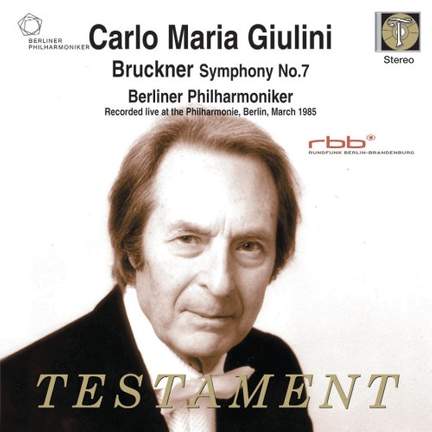
Bruckner: Symphony No. 7 in E Major
Berliner Philharmoniker, Carlo Maria Giulini
Purchase product
About
The main item of Giulini's Philharmonic concerts on 5 and 6 March 1985 was Bruckner's Seventh Symphony, the core of which is the extended Adagio movement. "His quintessentially romantic interpretation drove the incessant melodic stream across breaks, only held back at the great formal caesuras, such as at the start of the recapitulation. But there were some exceptions: the deliberate change of tempo in the Trio of the Scherzo and, more particularly, in the Finale, the disjointedness of which Giulini contrasted dramatically with the continuity of the preceding movements." (Albrecht Dümling in Der Tagesspiegel, 7 March.) According to Klaus Geitel, writing in the Berliner Morgenpost on 7 March, a new generation of Bruckner interpreters, no longer based on the German catholic faith, had followed Mahler. Also, new music had heightened awareness of the continuing modernity of the old; Bruckner's works were likely to present more surprises. "It was due to Giulini that his interpretation of Bruckner balanced on the cusp between the might of the old and an insight into the new. The brass passages, full of radiance and grandeur, were introduced by the wind section like earthquakes of sound. But there was also an element of gentle serenity, imbuing the Adagio with solemnity. Under Giulini the symphony developed the free interplay of musical forces in obsolete symphonic forms." From the booklet note by Helge Grünewald.