Delius: Danish Masterworks
Johan Reuter, Henriette Bonde Hansen
Aarhus Symphony Orchestra, Bo Holten
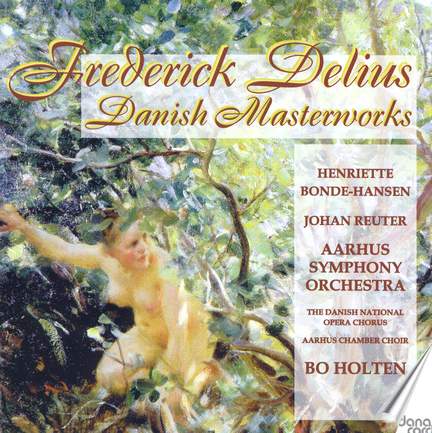
This collection of Delius's Danish inspirations, beautifully performed and recorded, makes a delightful disc, including as it does rarities that are otherwise unavailable. Even if 'masterworks'...
Delius: Danish Masterworks
Johan Reuter, Henriette Bonde Hansen
Aarhus Symphony Orchestra, Bo Holten
Purchase product

We pay more royalties to artists and composers than any other streaming service with our innovative Fair Play pay-per-second model
We pay artists and composers fairly with our pay-per-second model
This collection of Delius's Danish inspirations, beautifully performed and recorded, makes a delightful disc, including as it does rarities that are otherwise unavailable. Even if 'masterworks'...
About
Contents and tracklist
- Johan Reuter
- Danish National Opera Choir, Aarhus Chamber Choir, Aarhus Symphony Orchestra
- Bo Holten
- Henriette Bonde-Hansen
- Aarhus Symphony Orchestra
- Bo Holten
Delius:
Vi lo jo for saa laenge (In bliss we walked with laughter) [In Bliss We Walked With Laughter]
Work length2:47
- Henriette Bonde-Hansen
- Aarhus Symphony Orchestra
- Bo Holten
- Henriette Bonde-Hansen
- Aarhus Symphony Orchestra
- Bo Holten
- Henriette Bonde-Hansen
- Aarhus Symphony Orchestra
- Bo Holten
- Henriette Bonde-Hansen
- Aarhus Symphony Orchestra
- Bo Holten
- Henriette Bonde-Hansen
- Aarhus Symphony Orchestra
- Bo Holten
- Henriette Bonde-Hansen
- Aarhus Symphony Orchestra
- Bo Holten
- Henriette Bonde-Hansen
- Aarhus Symphony Orchestra
- Bo Holten
- Henriette Bonde-Hansen
- Aarhus Symphony Orchestra
- Bo Holten
- Henriette Bonde-Hansen
- Aarhus Symphony Orchestra
- Bo Holten
- Henriette Bonde-Hansen
- Aarhus Symphony Orchestra
- Bo Holten
- Henriette Bonde-Hansen
- Aarhus Symphony Orchestra
- Bo Holten
Awards and reviews
 2010
2010
This collection of Delius's Danish inspirations, beautifully performed and recorded, makes a delightful disc, including as it does rarities that are otherwise unavailable. Even if 'masterworks' is a bit of an exaggeration, the pieces here all show Delius at his most characteristic, drawing on his deep sympathy for Scandinavia and its culture.
Significantly, the performances under Bo Holten tend to be faster and often more passionate than those on rival recordings, such as in Unicorn's admirable Delius Collection.
An Arabesque dates from 1911, but all the other vocal items were written much earlier. In many ways the conventional picture we have of Delius, as the blind and paralysed composer of his later years, is misleading, failing to reflect what we know of the younger man, active and virile, a point that Bo Holten has clearly registered. It's good to have the Seven Danish Songs of 1897 as a group in Delius's own sensuous orchestrations.
The self-quotations in the ballad- like 'Irmelin Rose' are the more telling in orchestral form, and the most beautiful song of all, 'Summer Nights', is magically transformed in its atmospheric evocation of a sunset.
Delius also orchestrated two separate Danish songs, 'The Violet' and Summer Landscape as well as Sakuntala, prompting Holten to orchestrate the five other Danish songs, which here form another orchestral cycle. These, too, are more beautiful than with piano, even though Holten is less distinctive than Delius himself in his use of orchestral colour, notably in woodwind writing. All these songs are sung in the original language, where the Unicorn series opted for the English translations which Delius either made himself or approved. The two singers here may not be as characterful as such British soloists as Felicity Lott, Sarah Walker or Thomas Allen (in An Arabesque), but they both have fresh young voices, clear and precise, with Henriette Bonde-Hansen shading her bright soprano down to the gentlest pianissimos. The choral singing, too, is excellent in An Arabesque.
The Fennimore and Gerda 'Intermezzo' is relatively well known, but Lebenstanz ('Life's Dance'), inspired by a play of Helge Rode, is a rarity, otherwise available only on Unicorn conducted by Norman Del Mar. Here, too, Holten opts for marginally faster speeds in a piece depicting (in the composer's words) 'the turbulence, the joy, energy, great striving of youth'. The dance sections – one of them surprisingly Straussian – are punctuated by typically reflective passages, and the depiction of death at the end is peaceful and not at all tragic.
The Aarhus Symphony Orchestra respond warmly to Holten's idiomatic direction, and the refined playing is quite closely balanced in a helpful acoustic.