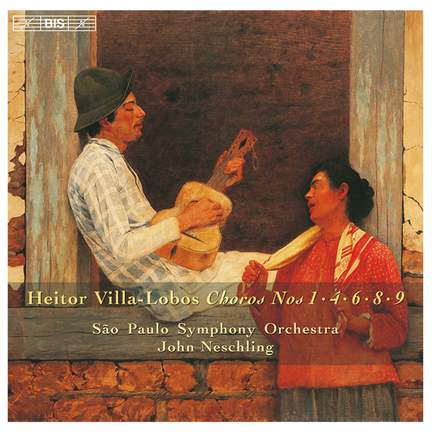
Villa-Lobos - Chôros Volume 2
Fabio Zanon (guitar), Dante Yenque, Ozéas Arantes & Samuel Hamzem (horn) & Darrin Coleman Milling (bass trombone), Linda Bustani and Ilan Rechtman (piano)
São Paulo Symphony Orchestra, John Neschling
Awards:
-
Gramophone Magazine, October 2008, Editor's Choice

-
Diapason d’Or de l’Année, 2009

How many Chôros are there? Fourteen numbered examples (with two claimed as “lost”), two Chôrosbis, a Wind Quintet en forme de Chôros and a con- cluding (!) choral-and-orchestral “Introduction...
Villa-Lobos - Chôros Volume 2
Fabio Zanon (guitar), Dante Yenque, Ozéas Arantes & Samuel Hamzem (horn) & Darrin Coleman Milling (bass trombone), Linda Bustani and Ilan Rechtman (piano)
São Paulo Symphony Orchestra, John Neschling
Purchase product

Awards:
-
Gramophone Magazine, October 2008, Editor's Choice
-
Diapason d’Or de l’Année, 2009
How many Chôros are there? Fourteen numbered examples (with two claimed as “lost”), two Chôrosbis, a Wind Quintet en forme de Chôros and a con- cluding (!) choral-and-orchestral “Introduction...
About
After a highly acclaimed 3-disc traversal of Villa-Lobos’ 9 Bachianas Brasileiras, the São Paulo Symphony Orchestra (OSESP) takes on the Choros by the same composer, in a cycle supervised by the orchestra’s artistic director John Neschling. In the Choros, composed between 1920 and 1929, Villa-Lobos’ point of departure is the Brazilian popular genre called choro, and he described his Choros as a synthesis of ‘the different modalities of indigenous and popular Brazilian music’, adding that the word ‘serenade’ gives an approximate idea of what Choros is. This vagueness was probably intentional – Villa-Lobos wanted to catch the improvisatory aspect of the genre, and as a result the works are very varied. The cycle includes brief solo pieces, chamber settings and full-length works for large symphony orchestra, with or without solo instruments or choir, as exemplified by the first volume of this series, released in February 2008. This received a Diapason d’or in the French magazine Diapason, and a review that described the performance of No.7 – for seven players – ‘a lesson in agogic freedom’ and the monumental No.11 – for piano and orchestra – ’a master-piece that opens up onto an almost infinite acoustic universe’, applauding the ’extraordinary interpretation’ by Cristina Ortiz and the orchestra. Volume 2 includes the first of the Choros, for solo guitar, as well as No.4 for three horns & trombone, but also three large-scale orchestral works, adding further facets to this fascinating and kaleidoscopic cycle.
Contents and tracklist
- São Paulo Symphony Orchestra
- John Neschling
- Recorded: August 2004
- Recording Venue: Sala Sao Paulo, Brazil
- Fabio Zanon (guitar)
- Recorded: December 2003
- Recording Venue: Sala Sao Paulo, Brazil
- Linda Bustani (piano), Ilan Rechtman (piano)
- São Paulo Symphony Orchestra
- John Neschling
- Recorded: February 2005
- Recording Venue: Sala Sao Paulo, Brazil
- Dante Yenque (horn), Ozeas Arantes (horn), Samuel Hamzem (horn), Darrin Coleman Milling (bass trombone)
- Recorded: August 2004
- Recording Venue: Sala Sao Paulo, Brazil
- São Paulo Symphony Orchestra
- John Neschling
- Recorded: August 2004
- Recording Venue: Sala Sao Paulo, Brazil
Awards and reviews
-
Gramophone MagazineOctober 2008Editor's Choice
-
Diapason d’Or de l’Année2009
 2010
2010
How many Chôros are there? Fourteen numbered examples (with two claimed as “lost”), two Chôrosbis, a Wind Quintet en forme de Chôros and a con- cluding (!) choral-and-orchestral “Introduction to the Chôros”, all more or less from the 1920s.
No 6 (1926), which opens this second volume of BIS's survey, and No 9 (1929) may not have been written down until 1942 in time for their Rio premieres. Villa-Lobos was unreliable about many details of his work and these would not be unique in his output in being created only when performances finally materialised.
Whenever it was set down, the Sixth is a hugely engaging, if sprawling, orchestral fantasia and like the Eighth (written and premiered between 1925 and 1927) and Ninth, was scored for large orchestra using exotic local percussion instruments. The Eighth is far more barbaric in character, tailored for the fad for primitivism then fashionable in Paris (where it was written), with parts for two pianos. Yet this is no concerto in disguise; although the first is a melodic soloist, the second is deployed as a percussive instrument and both orchestrally. BIS provides a clear balance.
Neschling and the São Paulo SO have the edge in the Ninth, which lies expressively between Nos 6 and 8. Separating these difficult orchestral works come the First for guitar (1920-21) and Fourth for brass (1926). There have been crisper performances of the latter, but Fabio Zanon's of the well known First is really rather good, languid and wistful, the tempi vibrantly elastic. This fine disc augurs well for what will presumably be the final instalment.
 October 2008
After the excellent previous volume this successor - as well played as ASV's still incomplete rival survey - augurs well for what will presumably be the final instalment.
 25th July 2008
Villa-Lobos's textural inventiveness is a constant delight in both [Choros 8 & 9] and the São Paulo Symphony's performances under John Neschling exploit it to maximum effect.