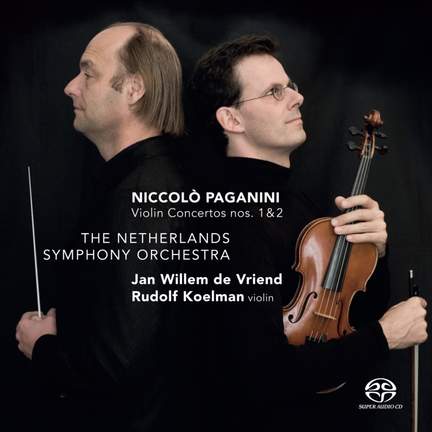
Paganini - Violin Concertos Nos. 1 & 2
Rudolf Koelman (violin)
Netherlands Symphony Orchestra, Jan Willem de Vriend
He plays both concertos in a bold, dashing manner, keeping to a minimum the traditional changes of tempo, and achieving a strong sense of continuity and cohesion. The quick movements have a...
Paganini - Violin Concertos Nos. 1 & 2
Rudolf Koelman (violin)
Netherlands Symphony Orchestra, Jan Willem de Vriend
Purchase product

He plays both concertos in a bold, dashing manner, keeping to a minimum the traditional changes of tempo, and achieving a strong sense of continuity and cohesion. The quick movements have a...
About
On this hybrid SACD the highly regarded Dutch soloist Rudolf Koeman plays Paganini’s first two Violin Concertos with the Netherlands Symphony Orchestra and conductor Jan Willem de Vriend. In order to reflect the virtuosic and operatic style of the concertos, the disc also includes an overture by Rossini entitled “Matilda di Shabran”.
The combination of Paganini’s first two Violin Concertos and a Rossini operatic overture “Matilde di Shabran” points to Paganini’s style of composing. The individual movements are in many ways similar to virtuosic or lyrical opera arias where the solo violin replaces the human voice. Also, like Rossini, Paganini uses a high degree of ornamentation to enhance the expressive quality of music.
Rudolf Koelman was born in Amsterdam in 1959. In 1972 he began an extensive study of the violin under Herman Krebbers at the Conservatory of Amsterdam, and from 1978 to 1981 he was one of Jascha Heifetz’s last pupils at the University of Southern California in Los Angeles. Until 1999 he was leader of the Royal Concertgebouw Orchestra, Amsterdam.
Contents and tracklist
- The Netherlands Symphony Orchestra, Rudolf Koelman
- Jan Willem de Vriend
- The Netherlands Symphony Orchestra, Rudolf Koelman
- Jan Willem de Vriend
- The Netherlands Symphony Orchestra, Rudolf Koelman
- Jan Willem de Vriend
Awards and reviews
 April 2010
He plays both concertos in a bold, dashing manner, keeping to a minimum the traditional changes of tempo, and achieving a strong sense of continuity and cohesion. The quick movements have a passionate character, especially the 'Campanella' finale of No. 2, where the orchestral tuttis catch the mood