Puccini: La Bohème
Jussi Björling, Victoria de los Angeles, Robert Merrill, Lucine Amara & Giorgio Tozzi
RCA Victor Chorus and Orchestra (Thomas Martin) & The Columbus Boychoir (Herbert Huffman), Sir Thomas Beecham
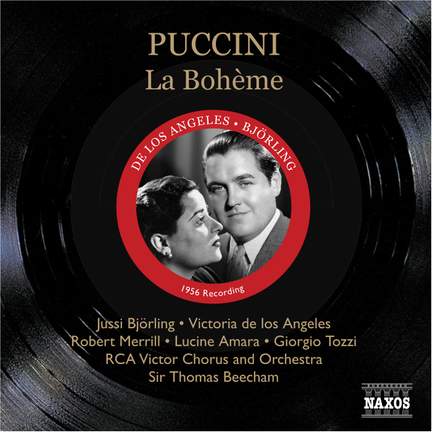
One of the great classics of recording, expertly restored. Victoria de los Angeles and Jussi Björling are an incomparable pair, and Beecham's conducting is, as ever, inimitable.
Puccini: La Bohème
Jussi Björling, Victoria de los Angeles, Robert Merrill, Lucine Amara & Giorgio Tozzi
RCA Victor Chorus and Orchestra (Thomas Martin) & The Columbus Boychoir (Herbert Huffman), Sir Thomas Beecham
Purchase product
One of the great classics of recording, expertly restored. Victoria de los Angeles and Jussi Björling are an incomparable pair, and Beecham's conducting is, as ever, inimitable.
About
Contents and tracklist
- Robert Merrill (baritone), William Nahr (tenor), George del Monte (baritone), Fernando Corena (bass), Victoria de los Angeles (soprano), Jussi Björling (tenor), John Reardon (baritone), Thomas Powell (baritone), Giorgio Tozzi (bass), Lucine Amara (soprano)
- RCA Victor Orchestra, RCA Victor Chorus, Columbus Boychoir
- Recorded: 16, 17, 30 March, 1-3, 5, 6 April 1956
- Recording Venue: Manhattan Center, New York City, USA
Act I: Questo "Mar Rosso" mi ammollisce e assidera (Marcello, Rodolfo)
Track length2:34
Act I: Aguzza l'ingegno (Rodolfo, Marcello, Colline)
Track length3:11
Act I: Legna! … Sigari! (Rodolfo, Marcello, Colline, Schaunard)
Track length3:41
Act I: Si puo? … Chi e la? (Benoit, Marcello, Schaunard, Colline, Rodolfo)
Track length4:35
Act I: Al Quartiere Latin ci attende Momus (Schaunard, Marcello, Rodolfo, Colline)
Track length2:10
Act I: Chi e la? (Rodolfo, Mimi)
Track length2:35
Act I: Oh! sventata, sventata! (Mimi, Rodolfo)
Track length1:44
Act I: Che gelida manina! (Rodolfo)
Track length5:00
Act I: Si. Mi chiamano Mimi (Mimi, Rodolfo)
Track length5:12
Act I: Ehi! Rodolfo! (Schaunard, Colline, Marcello, Rodolfo, Mimi)
Track length0:47
Act I: O soave fanciulla (Rodolfo, Marcello, Mimi)
Track length4:16
Act II: Aranci, datteri! (Chorus, Schaunard, Colline, Rodolfo, Mimì, Marcello)
Track length2:51
Act II: Chi guardi? (Rodolfo, Colline, Mimi, Schaunard, Marcello, Chorus, Parpignol)
Track length3:23
Act II: Viva Parpignol! (Chorus, Marcello, Mimi, Schaunard, Colline, Rodolfo)
Track length2:11
Act II: Oh! Musetta! (Rodolfo, Schaunard, Colline, Marcello, Chorus, Alcindoro, Musetta, Mimi)
Track length3:17
Act II: Quando men' vo soletta (Musetta, Marcello, Alcindoro, Mimi, Rodolfo, Schaunard, Colline)
Track length4:41
Act II: Chi l'ha richiesto? (Colline, Schaunard, Rodolfo, Chorus, Marcello, Musetta, Mimi)
Track length2:19
Act III: Ohe, la, le guardie! … Aprite! (Chorus, Customs Officer, Musetta)
Track length3:35
Act III: Sa dirmi, scusi, qual'e l'osteria (Mimi, Sergeant, Customs Officer)
Track length1:31
Act III: Mimi! … Speravo di trovarvi qui (Marcello, Mimi)
Track length5:05
Act III: Marcello. Finalmente. (Rodolfo, Marcello, Mimi)
Track length1:22
Act III: Mimi e una civetta (Rodolfo, Marcello)
Track length1:27
Act III: Mimi e tanto malata! (Rodolfo, Marcello, Mimi)
Track length3:18
Act III: Addio … D'onde lieta usci al tuo grido d'amore (Mimi, Rodolfo)
Track length3:16
Act III: Dunque e proprio finita? (Rodolfo, Mimi)
Track length1:51
Act III: Che facevi? Che dicevi? (Marcello, Musetta, Mimi, Rodolfo)
Track length3:30
Act IV: In un coupe? (Marcello, Rodolfo)
Track length1:25
Act IV: O Mimi, tu piu non torni (Rodolfo, Marcello)
Track length2:59
Act IV: Che ora sia! … L'ora del pranzo (Rodolfo, Marcello, Schaunard, Colline)
Track length2:20
Act IV: Gavotta … Minuetto … Pavanella (Colline, Marcello, Rodolfo, Schaunard)
Track length1:43
Act IV: C'e Mimi … c’e Mimi (Musetta, Rodolfo, Schaunard, Mimi, Marcello)
Track length3:24
Act IV: Ho tanto freddo. Se avessi un manicotto! (Mimi, Rodolfo, Musetta, Marcello, Schaunard)
Track length3:00
Act IV: Vecchia zimarra (Colline, Schaunard)
Track length2:22
Act IV: Sono andati? Fingevo di dormire (Mimi, Rodolfo)
Track length3:17
Act IV: Mi chiamano Mimi … il perche non so (Mimi, Rodolfo, Schaunard)
Track length3:20
Act IV: Dorme? … Riposa (Musetta, Rodolfo, Marcello, Mimi, Schaunard, Colline)
Track length5:03
Beecham:
Sir Thomas Beecham speaks about La boheme
Work length1:22
- Sir Thomas Beecham (voice)
- Recorded: 1956
- Recording Venue: New York City
Work length31:10
- Dora Labbette (soprano), Robert Easton (bass), Heddle Nash (tenor), John Brownlee (baritone), Stella Andreva (soprano), Robert Alva (baritone)
- London Philharmonic Orchestra
- Recorded: 3 April 1936
- Recording Venue: EMI Abbey Road Studio No. 1, London, UK
La boheme, Act III: D'onde lieta usci al tuo grido d'amore, "Mimi's Farewell"
Track length3:35
Act IV: In un coupe? (Marcello, Rodolfo)
Track length1:23
Act IV: O Mimi, tu piu non torni (Rodolfo, Marcello)
Track length3:07
Act IV: Che ora sia! … L'ora del pranzo (Rodolfo, Marcello, Schaunard, Colline)
Track length2:24
Act IV: Gavotta … Minuetto … Pavanella (Colline, Marcello, Rodolfo, Schaunard)
Track length1:41
Act IV: C'e Mimi … c'e Mimi (Musetta, Rodolfo, Schaunard, Mimi, Marcello)
Track length2:57
Act IV: Ho tanto freddo. Se avessi un manicotto! (Mimi, Rodolfo, Musetta, Marcello, Schaunard)
Track length2:35
Act IV: Vecchia zimarra (Colline, Schaunard)
Track length2:20
Act IV: Sono andati? Fingevo di dormire (Mimi, Rodolfo)
Track length3:02
Act IV: Mi chiamano Mimi … il perche non so (Mimi, Rodolfo, Schaunard)
Track length3:14
Act IV: Dorme? … Riposa (Musetta, Rodolfo, Marcello, Mimi, Schaunard, Colline)
Track length4:52
Awards and reviews
 July 2007
One of the great classics of recording, expertly restored. Victoria de los Angeles and Jussi Björling are an incomparable pair, and Beecham's conducting is, as ever, inimitable.
 2010
2010
The disadvantages of this famous Beecham Bohème are obvious. It's a mono recording and restricted in dynamic range. The sense of space for the complex crowd scene of Act 2 is to emerge with the maximum impact is inevitably lacking; the climaxes here and elsewhere are somewhat constricted; no less important, it's sometimes harder to focus on the subtleties of Puccini's orchestration. It was also made in a great hurry, and this shows in a number of patches of slightly insecure ensemble, even a couple of wrong entries. But there's no other important respect in which it doesn't stand at least half a head (often head and shoulders) above its more recent rivals. Nobody has ever been so predestinately right for the role of Mimì than Victoria de los Angeles: right both in vocal quality and in sheer involvement with every word and every musical phrase that Mimì utters. Beyond a certain point (usually a certain dynamic level) most sopranos stop being Mimì and simply produce the same sound that they would if they were singing Aida or Tosca. De los Angeles rarely does this; even under pressure (and Beecham's unhurried tempos do put her under pressure at times), the very difficulties Opera Puccini 872 themselves are used as an expressive and interpretative resource. Hers is the most moving and involving Mimì ever recorded. And Björling's is the most musical Rodolfo. He has the reputation of having been a bit of a dry stick, dramatically (on stage he looked like the other Bohemians' elderly, portly uncle), but on record he's the one exponent of the role to be credible both as a lover and as a poet. His voice is fine silver rather than brass, it can caress as well as weep, and his love for Mimì is more often confided than it is bellowed for all Paris to hear. This, indeed, is one of the most conspicuous differences between Beecham's account and most others: its simple belief that when Puccini wrote pp he meant it.
Beecham (whose spell over his entire cast – in which there's no weak link – extends as far as teaching his Schaunard, John Reardon, an irresistibly funny, cut-glass English accent for the parrot-fancying milord) makes one realise what an intimate opera this is, how much of it is quiet, how many of its exchanges are sotto voce, and he thus enables his singers to use the full range of their voices and to employ subtleties of colour, phrasing and diction that are simply not available to a voice at full stretch (and in the process he largely cancels out the disadvantage of his recording's restricted dynamic range). It's the same with his handling of the orchestra: one would expect Beecham to seem understated, but again and again one turns back to his reading and discovers nothing missing – he has achieved as much or more with less. This is as complete a distillation of Puccini's drama as you're likely to hear.
(The EMI set is not currently listed in the UK, and the Naxos is not available in the United States, Australia and Singapore due to possible copyright restrictions.)