Respighi: Piano Works
Konstantin Scherbakov (piano), Ivan Tvrdik (cello)
Slovak Radio Symphony Orchestra, Howard Griffiths
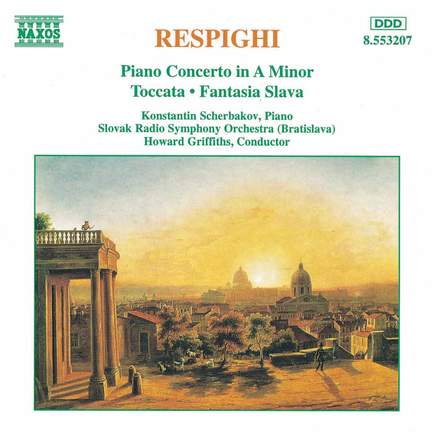
All these pieces are otherwise available in decent performances, but at this price how could anyone with the slightest weakness for Respighi hesitate? Scherbakov and Griffiths do a good deal...
Respighi: Piano Works
Konstantin Scherbakov (piano), Ivan Tvrdik (cello)
Slovak Radio Symphony Orchestra, Howard Griffiths
Purchase product

We pay more royalties to artists and composers than any other streaming service with our innovative Fair Play pay-per-second model
We pay artists and composers fairly with our pay-per-second model
All these pieces are otherwise available in decent performances, but at this price how could anyone with the slightest weakness for Respighi hesitate? Scherbakov and Griffiths do a good deal...
About
Contents and tracklist
Work length20:21
This work is only available as an album download.
Concerto for Piano and Orchestra in A Minor
Track length20:21
This track is only available as an album download.
Work length21:43
This work is only available as an album download.
Toccata for Piano and Orchestra
Track length21:43
This track is only available as an album download.
Awards and reviews
 2010
2010
All these pieces are otherwise available in decent performances, but at this price how could anyone with the slightest weakness for Respighi hesitate? Scherbakov and Griffiths do a good deal more than dutifully go through the motions, the soloist in particular playing with delicacy and affection, grateful for the opportunities to demonstrate how well he would play Liszt or Rachmaninov, but in the Toccata he's interested as well in Respighi's more characteristic modal vein; as a Russian, he demonstrates that this too, like so much in Respighi, was influenced by the time he spent in Russia.
Russian soloist, English conductor and Slovak orchestra all enjoy the moment in the Fantasiaslava where Respighi presents a morsel of Smetana in the evident belief that it's a Russian folk-dance, but the Concerto and the Fantasia, both very early works, aren't patronised in the slightest.
The Toccata isn't so much an exercise in the neo-Baroque, often though its dotted and florid figures promise it, more of an essay on how far one can be neo-Baroque without giving up a post-Lisztian keyboard style and comfortable orchestral upholstery. But in a slow and florid central section, a rather melancholy aria that passes from the soloist to the oboe, to the strings and back again, there's a real quality of Bachian utterance translated not unrecognisably into a late Romantic language. Scherbakov sounds touched by it, and obviously wants us to like it.
The recordings are more than serviceable, but each work is given only a single track.

How could anyone with the slightest weakness for Respighi hesitate?