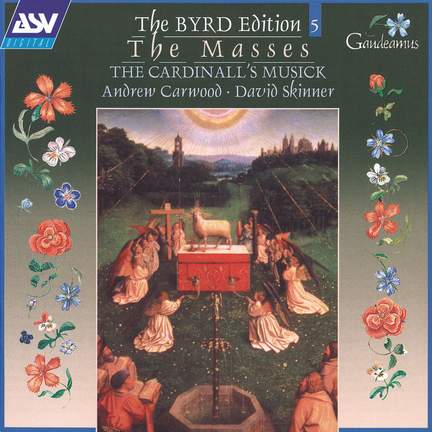
Byrd Edition Volume 5 - The Masses
David Skinner
Cardinall's Musick, Andrew Carwood
Awards:
-
Building a Library, December 2003, First Choice

-
Building a Library, June 2013, First Choice
-
Penguin Guide, Rosette

The singing is technically polished, the tuning faultless and the overall sonority rounded and rich.
Byrd Edition Volume 5 - The Masses
David Skinner
Cardinall's Musick, Andrew Carwood
Purchase product

We pay more royalties to artists and composers than any other streaming service with our innovative Fair Play pay-per-second model
We pay artists and composers fairly with our pay-per-second model
Awards:
-
Building a Library, December 2003, First Choice
-
Building a Library, June 2013, First Choice
-
Penguin Guide, Rosette
The singing is technically polished, the tuning faultless and the overall sonority rounded and rich.
About
These intimate, dark, mystical settings are creations of great feeling, expressing the sorrow of deprivation. All three masses reach an intensity rarely equalled in Renaissance times, and culminating in Agnus Dei settings which are among the most poignantly beautiful in all music. These will remain definitive performances for many years to come. Each mass in preceded by an organ Fantasia. Suprisingly there is only one other modern issue currently to present all three masses on a single CD.
Contents and tracklist
- Patrick Russill (organ)
- Recorded: 1999-11-24
- Recording Venue: Fitzalan Chapel, Arundel Castle, Arundel
- The Cardinall’s Musick
- Andrew Carwood
- Recorded: 1999-11-24
- Recording Venue: Fitzalan Chapel, Arundel Castle, Arundel
- Patrick Russill (organ)
- Recorded: 1999-11-24
- Recording Venue: Fitzalan Chapel, Arundel Castle, Arundel
- The Cardinall’s Musick
- Andrew Carwood
- Recorded: 1999-11-24
- Recording Venue: Fitzalan Chapel, Arundel Castle, Arundel
- Patrick Russill (organ)
- Recorded: 1999-11-24
- Recording Venue: Fitzalan Chapel, Arundel Castle, Arundel
- The Cardinall’s Musick
- Andrew Carwood
- Recorded: 1999-11-24
- Recording Venue: Fitzalan Chapel, Arundel Castle, Arundel
Awards and reviews
-
Penguin GuideRosette

The singing is technically polished, the tuning faultless and the overall sonority rounded and rich.
 2010
2010
This is incomparable music by one of the great est English composers and it was high time for someone to take a fresh look at these works in the light of more recent research and of changing attitudes to performance practice.
Byrd had composed his three settings of the Ordinary of the Mass in troubled times for the small recusant Catholic community that still remained in England in spite of persecution.
The settings would have been sung, in all probability, during festive, albeit furtive, celebrations of the old time-honoured Roman liturgy, in private chapels in the depths of the country, at places such as Ingatestone, the seat of Byrd's principal patron, Sir John Petre. Andrew Carwood has recorded them in the Fitzalan Chapel of Arundel Castle, a small but lofty building with a clear resonance that enables the inner voices of the part-writing to come through straight and clean. It hasn't the aura of King's College Chapel, but is probably easier to manage than, say, Winchester Cathedral or Merton College Chapel.
Carwood uses two voices to a part in all three Masses. In comparison with rival recordings he's alone in selecting high voices for the three-part Mass, transposed up a minor third, which introduces a note of surprising lightness and grace. He, too, is alone in taking the initiative of using an allmale choir for the four-part Mass – alto, tenor, baritone, bass. This close, low texture, together with the transposition down an augmented fourth, adds a fitting sense of gravity to the performance.
In particular, it heightens the poignancy of such passages as the 'dona nobis pacem' in the AgnusDei, with its series of suspensions in the drooping phrases leading to the final cadence.
That dimension of understanding is precisely what this recording by The Cardinall's Musick so keenly demonstrates. Theirs is a simplicity of style that belies simplistic criticism. Vibrato is used sparingly: 40 years on, some listeners might consider its constant use by a King's Choir of the late 1950s almost too overpowering. Carwood chooses his tempos with care, avoiding the modern tendency to speed everything up inordinately.
The interesting historical note on the whole background is a good pointer to what the listener may experience as the music unfolds.