Special offer. Rachmaninov: Songs, Vol. 2
Joan Rodgers (soprano), Maria Popescu (contralto), Alexandre Naoumenko (tenor), Sergei Leiferkus (baritone), Howard Shelley (piano)
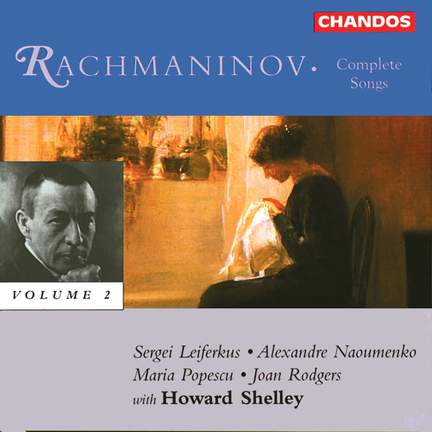
Two figures in particular haunt this second volume of Chandos's survey of Rachmaninov's songs – Feodor Chaliapin and Rachmaninov himself. They had become friends in the years when they worked...
Special offer. Rachmaninov: Songs, Vol. 2
Joan Rodgers (soprano), Maria Popescu (contralto), Alexandre Naoumenko (tenor), Sergei Leiferkus (baritone), Howard Shelley (piano)
Purchase product

We pay more royalties to artists and composers than any other streaming service with our innovative Fair Play pay-per-second model
We pay artists and composers fairly with our pay-per-second model
Two figures in particular haunt this second volume of Chandos's survey of Rachmaninov's songs – Feodor Chaliapin and Rachmaninov himself. They had become friends in the years when they worked...
About
Contents and tracklist
- Maria Popescu, Howard Shelley
- Sergei Leiferkus, Howard Shelley, Alexandre Naoumenko, Joan Rodgers, Maria Popescu
- Maria Popescu, Howard Shelley, Sergei Leiferkus, Joan Rodgers, Alexandre Naoumenko
Awards and reviews
 2010
2010
Two figures in particular haunt this second volume of Chandos's survey of Rachmaninov's songs – Feodor Chaliapin and Rachmaninov himself. They had become friends in the years when they worked together in an opera company and when Rachmaninov was concentrating on developing his piano virtuosity. As a result the Op 21 songs are dominated by an almost operatic declamatory manner coupled with formidably difficult accompaniments. Leiferkus rises splendidly to the occasion, above all in 'Fate' (Op 21 No 1), and so throughout the songs does Howard Shelley. He's unbowed by the technical problems and he understands the novel proportions of songs in which the piano's participation has an unprecedented role. He also enjoys himself in the roisterous exchanges with Leiferkus in what's really Rachmaninov's only lighthearted song, Were you hiccoughing? The songs for the other voices are less powerful, in general more lyrical and intimate.
Alexandre Naoumenko only has five songs, and they aren't, on the whole, among the more striking examples, but he responds elegantly to 'The fountain' (Op 26 No 11). Maria Popescu gives a beautiful account of one of the most deservedly popular of them all, 'To the children' (Op 26 No 7), and of the remarkable Merezhkovsky setting, 'Christ is risen' (Op 26 No 6). Joan Rodgers is enchanting in 'The Lilacs' (Op 21 No 5) and moving in the song acknowledging that love is slipping away, 'Again I am alone' (Op 26 No 9). She has complete mastery of the style, and nothing here is finer than her arching phrase ending 'How peaceful' (Op 21 No 7) – 'da ty, mechta moya' (and you, my dream) – with Shelley gently articulating Rachmaninov's reflective piano postlude from the world of Schumann.