Dukas: Piano Sonata
Marc-André Hamelin (piano)
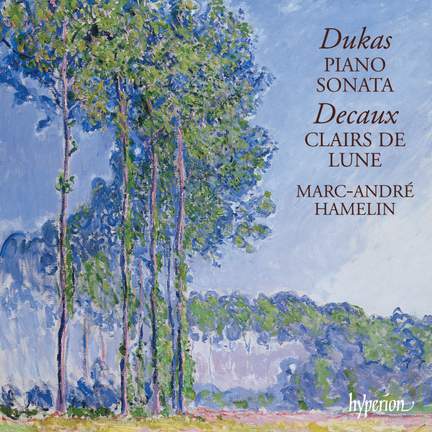
Awards:
-
BBC Music Magazine Awards, 2007, Instrumental Finalist

-
BBC Music Magazine, June 2006, Instrumental Choice

Dukas's E flat minor Sonata (1900) is a rare (the only?) French example of the form from this period. Lasting more than 45 minutes, each of its four movements is underpinned by almost unremitting...
Dukas: Piano Sonata
Marc-André Hamelin (piano)
Purchase product
Awards:
-
BBC Music Magazine Awards, 2007, Instrumental Finalist
-
BBC Music Magazine, June 2006, Instrumental Choice
Dukas's E flat minor Sonata (1900) is a rare (the only?) French example of the form from this period. Lasting more than 45 minutes, each of its four movements is underpinned by almost unremitting...
About
Dukas epic and dauntingly virtuosic sonata is one of the composers most important works and, in its demands, eminently suited to Marc-Andre Hamelins talents. When Dukas composed his piano sonata at the turn of the century he was consciously adopting a form that invited inevitable comparison with Beethoven, one conspicuously avoided by other French composers of the period. Dukas embraced the challenge, and his sonata is one of the most significant French Romantic piano works, performed relatively infrequently only because of its size and difficulty. It has been a part of Marc-Andre Hamelins concert repertoire for many years, and we are delighted that he has finally committed it to disc. Also on this CD are four almost completely unknown pieces by Abel Decaux which inhabit their own unique sound world between Scriabin and Debussy, although they explore an extraordinary tonal language that looks ahead to Schoenberg. Decaux is known to have composed nothing other than these four pieces (apart from a sketch for an unfinished fifth piece), written between 1900 and 1907. In the words of Roger Nichols, who supplies a fascinating booklet note, they seem to come from nowhere; and, indeed, for quite some time, to lead nowhere. Marc-Andre Hamelins compelling advocacy once again convinces us that not all little-known music deserves its obscurity.
Contents and tracklist
Awards and reviews
-
BBC Music MagazineJune 2006Instrumental Choice
 2010
2010
Dukas's E flat minor Sonata (1900) is a rare (the only?) French example of the form from this period. Lasting more than 45 minutes, each of its four movements is underpinned by almost unremitting motion. The chromaticism of the first owes an obvious debt to Franck; the second has prescient touches of Scriabin and Debussy; the outer sections of the third are an Alkanesque toccata with a haunting mystérieuse central section, while the equally virtuosic finale shows that while Dukas remains firmly his own man, he also knew his Schumann and Liszt.
Hamelin, one needs hardly say, makes light of any difficulty, clarifying complex textures and subtly highlighting different voices with myriad keyboard colours. It is this facility that sometimes leads to a certain coolness and lack of (audible) engagement. Not here: this performance has an expressive power and intense emotional involvement that make it one of his most successful recordings – and that is saying something.
For those who have never previously encountered Dukas's companion on this CD, Abel Decaux (1869-1943) – and you'd not be alone – was a French organist (pupil of Widor and Guilmant) who studied composition with Massenet. What the composer of Manon and Werther would have made of the four pieces that comprise Clairs de lune (note the plural), one can only guess. Written between 1900 and 1907, they were not published till a year after Massenet's death in 1912. Listen blindfold and you might think, as Roger Nichols points out in his informative notes, that you were listening to Schoenberg or Debussy – except that Decaux's pieces pre-date both of them. Not for everyday listening, but fascinating nevertheless and a further example of this great pianist's extraordinary musical savoir-faire and his invaluable, unflagging curiosity.
 July 2006
Dukas's E flat Sonata (1900) is a rare (the only?) French example of the form fro this period. Lasting more than 45 minutes, each of its four movements is underpinned by almost unremitting motion. Hamelin… makes light of any difficulty, clarifying complex textures and subtly highlighting different voices with myriad keyboard colours. ...this performance has an expressive power and intense emotional involvement that make it one of his most successful recordings - and that is saying something.