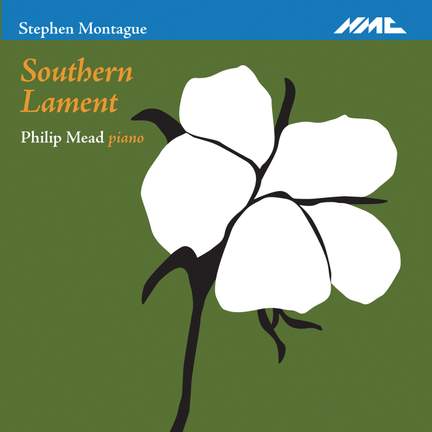
Southern Lament
Piano music by Stephen Montague
Philip Mead (piano)
…what hits you time and again in this disc is Stephen Montague's reverence for sound (in a Cageian sense), and his reverence for a truthfulness that treads an adroitly-negotiated path between...
Southern Lament
Piano music by Stephen Montague
Philip Mead (piano)
Purchase product

…what hits you time and again in this disc is Stephen Montague's reverence for sound (in a Cageian sense), and his reverence for a truthfulness that treads an adroitly-negotiated path between...
About
This collection of Stephen Montague's music for piano explores his roots in the Southern USA - including spirituals such as Nobody Knows the Trouble I've Seen - and the legacy of American experimental composers such as Charles Ives and John Cage with wit and energy. Pianist Philip Mead (also heard on Lucifer) is joined by singer Monica Acosta, flautist Nancy Ruffer, the Elysian Quartet, the London Sousa Band, and the composer himself on electronics and piano. 'A consistently enjoyable portrait of a composer who knows how to focus his appeal. Terrific performances from Philip Mead, all well recorded.' Gramophone 'Why we like it: The haunting title piece plays off the composer's upbringing in Florida in the 1950s and '60s by reworking folk tunes John Henry and Nobody Knows the Trouble I've Seen. Paramell Va has great hard-driving piano. For Merce C at the Barbican is a tribute to choreographer Merce Cunningham. Reminds us of: John Cage Download these: After Ives, Paramell Va Grade: A' St Petersburg Times, Florida 'Southern Lament flags up the 1997 soundscape charting the American Deep South as distilled in its ballads and spirituals. A deconstruction as gritty as coarse sandpaper, as tender as a powerfully imagined lament. The other big work is "After Ives...", a salute from one maverick to another that contrives a hoe-down for the end of time amid a deal of gleeful ambiguity... Philip Mead, a longtime collaborator with Montague, sweeps all before him. Formidable pianism, ear-stretching music.' BBC Music Magazine, 2006
Contents and tracklist
- Philip Mead, Monica Acosta
- Philip Mead
- Elysian Quartet
- Stephen Montague, Philip Mead
- Philip Mead
- Elysian Quartet
- Stephen Montague
- Stephen Montague, Philip Mead
- Stephen Montague, Philip Mead
- Stephen Montague
- Philip Mead, Nancy Ruffer
- Elysian Quartet, London Sousa Band
- Stephen Montague
Awards and reviews
 April 2006
…what hits you time and again in this disc is Stephen Montague's reverence for sound (in a Cageian sense), and his reverence for a truthfulness that treads an adroitly-negotiated path between visceral immediacy and intellectual ingenuity.
 2010
2010
Stephen Montague is an American composerperformer who has lived in the UK for more than 30 years, during which time he has developed an enterprising international career. He honestly admits his sources in Ives, Cowell, Cage and minimalism, and the CD ends with four of his Studies 'after Ives'. That wonderful hymn tune 'What a friend we have in Jesus' (compare Montague's treatment with the third movement of Ives's Piano Sonata No 1) shows the unabated power of diatonic harmony, although there are surprises, and 'Forever JPS' is a spectacular which brings in the voice of Sousa himself as well as the London Sousa Band in Stars and Stripes.
Montague points out that when he borrows melodies, unlike Ives he usually quotes them complete. There's plenty of that with the varied settings of the tunes in Southern Lament. Then there are several short occasional pieces showing variety and ingenuity, but Haiku with live electronics and computer tape is more substantial.
This is a subtle, oriental-influenced piece with the live piano gracefully repetitive and the electronics sustaining this mood. When Montague uses electronics the sound is always beguiling; if he's minimalist he gets somewhere rather than being stuck in a groove; and he even manages to use tone-clusters with a light touch.
This is a consistently enjoyable portrait of a composer who knows how to focus his appeal.
Terrific performances from Philip Mead, all well recorded.